Does the iPhone kill creativity?

It feels good to be writing again. Earlier today, I was wondering why I ever stopped. The iPhone and iPad crossed my mind but I wasn’t quite sure how they related to my decreased creative impulse. I haven’t been lazy. Quite the opposite, I’ve been productivity obsessed. In the two years since I got my first iPhone and iPad, I’ve been busier, more productive and better informed that ever before.

In my small amount of free-time I have been Facebooking, tweeting, following RSS news feeds, setting up search builder alerts in library databases, blogging, and sharing links of interest to colleagues across the state. I have become ridiculously well-informed through the miracles of Twitter, Google Reader, Flipboard, Zite, Vodio and Instapaper. I’ve been gathering weblinks like a manic squirrel and stashing them in Evernote, Google Bookmarks, and various other digital hidey holes.

The trouble is, I haven’t been taking the time to process all of this information or wonder exactly what it is for.

The universe is often kind. I was pondering all of these things earlier today, wondering how they fit together and then I read Jay Fields’ LifeHacker post “Is Productivity Killing Your Creativity?”

Creativity requires downtime. Insights are created in the space between activities where seemingly unrelated events are casually examined and relationships are found. Fields, like me, loves his iPhone. The trouble is, the iPhone destroys downtime. The mind is hungry for information and the hand so easily reaches for the iPhone when standing in line, waiting for the bus, waiting for the kid to get dressed, whatever. The idea is that these moments between things used to be filled with free-ranging thoughts, which created the building blocks required to make new ideas. When the mind is always engaged in taking in new information, there is no time left to make anything happen with this information.

Fields writes:

I’m convinced that my iPhone was the root of my creativity issues. Life is full of ‘waiting time’ – waiting for the subway, waiting to see your doctor, waiting in the elevator, waiting in line at airport/grocery store/coffee shop, and waiting at the bar to meet your friends. Pre-iPhone I would spend this waiting time pondering anything that was troubling me. Now, I open Safari on my iPhone to see who is the latest injury on the FSU, or who’s tweeting about what (seems like it’s mostly sponsorship requests these days). I don’t spend that time thinking about anything, I spend that time reading – reading about things that have very little impact on my life, but seem to always more than fill my waiting time.

I’m not planning to surrender my iPhone, but I like Fields’ rather modest solution. He moved the attention-suckers to the second screen of his iPhone so that when he instinctively reached for the device, he had time to remind himself that he needs time to think. Fields also schedules “stare out the window time” into his day. Both of these are doable solutions.

I want to sustain habits that foster greater creativity. I still want to be ridiculously well-informed, but I need time to figure out how this information involves my life. I need time to do things with the stuff I learn.

Funny how the answers we need often arrive just when we need them. Or maybe, I’ve just slowed my mind down enough to create a relationship between two entirely unrelated events. Either way, I am feeling grateful.
Flash Fiction: “Our Autumn Town”

For a long time, my writing has suffered from an expectation that the things I write need to be finished, polished and complete before they are read. Finished, polished and complete are all important. The unspoken corollary is that writing must be perfect before it is read.  That belief has made my writing a lonely, sometimes painful, act.

I am trying to kill that mental habit by writing in public. Posting these unfinished, unpolished snatches of “flash fiction” helps me subvert the belief that the point of writing is to make perfect things. I am practicing with the idea that the point of writing is to be read.

So here’s another piece I wrote last night. I was listening to “Autumn in Our Town” by Dave Brubeck and Ranny Sinclair.

*****

He hadn’t meant to pick up the phone. Dialing her number was sheer mutiny, and yet, here he was, pressing the numbers, his fingers finding the buttons from long lost habit deeper than memory. They hadn’t spoken in years. He couldn’t quite remember why. There had been a reason. A good reason.

The phone was ringing. He closed his eyes, trying to remember the color of her eyes. They had been green. Her eyes were slightly misaligned, though he couldn’t well remember if they had moved more to the left or the right. It was a thing he noticed when she stared at him. She had stared at him a lot, a bit like an idiot perhaps but the remembered impression of that stare was powerfully erotic.

How had they met? Was it in physics class? Had they been lab partners? Or had they met, perhaps, in the library? Maybe it was on the bus? Had he ever ridden a bus? Where would he have ridden a bus?

These questions crowded as the phone rang — once, twice, three times. He was about to hang up feeling foolish for indulging this fantastic whim when the line opened and a voice spoke.

“Hello?” A man’s voice with a British accent. She had always loved men with British accents. She had made him hate his own Southern Georgia drawl, he remembered suddenly. So many things she had helped him hate about himself, he realized with sudden panic.

“Hello?” the Englishman said again with that tone of patient annoyance that must have driven her wild. “Is anyone there?” he asked.

A choking croak rose in his throat when he tried to answer.

“Hello?” the Englishman said again, this time less patient, more annoyed. “Is there someone on the line? Can I help you?”

He swallowed a second croak, which went down his throat like a thing with a hundred legs. The taste of bile. He was dizzy and sweating a little.

“May I speak to Celine?”

The man on the other end grew silent except for suddenly labored breath. There was a moment when the latent sound of telephone wire was the only sound shared between them. And then, the British man spoke, “May I ask who’s calling?”

“I’m an old friend of Celine’s,” he said quickly. Even as he spoke the words, they sounded wrong to him. Even to his own ears, they sounded very much a lie. “Norbert,” he added, realizing he needed to add more information.  “My name is Norbert.”

The British man was being careful now. “Norbert,” he said, as if practicing the name for the first time.

“Yes. Is Celine there?”

The British man sighed. “No. Celine isn’t available. She can’t speak on the phone.”

Norbert pondered the odd turn of phrase. “May I leave her a message? Like I said, I’m an old friend. This is terribly important.”

The man sighed again. “Terribly important.” He said it as if taking dictation. “How long has it been since you last spoke to Celine?”

Norbert sensed a trap. Besides, his mind couldn’t capture how long it had been. Surely twenty years or more. Maybe thirty. Yet standing there, having dialed Celine’s number on his phone, he felt as if he had spoken with her as recently as yesterday. Time was a tricky thing. It folded in on you and doubled over while you were not looking. Things that happened yesterday seemed years ago and things from years ago were as close to hand as yesterday.

“Not sure. Years, I’m sure,” Norbert said.

“Years,” the British man confirmed. “I see.” Now it was a clinical pronouncement, the way a doctor might deliver hard medicine. “Bad news, I’m afraid, Norbert. Celine isn’t well. She hasn’t been herself. For years, I’m afraid.”

“Not herself?” Norbert asked. “Then who has she been?”

“I’m sorry. I really must be going now.”

“Please.” The edge of panic in his voice surprised Norbert. Her eyes had been green. They had tracked slightly to the left when staring at him. She had a spray of pale freckles across the bridge of her nose and her eyebrows were thinner at the centers than at either side. “I need to speak with Celine. It’s very important.”

Another sigh. “Celine isn’t here. She can’t be here. She is in hospital for people who aren’t themselves.”

He waited for the words to sink in.

“A hospital for people who aren’t themselves?” Norbert asked, feeling dense.

“Psychiatric,” the man said, his tone deadly dull.

“I see.” It was the only thing Norbert could think to say. And then, “Still, it is very important I reach her. Is there a number I can try?”

“You aren’t getting this,” the man said again. “My wife isn’t able to take your call. She isn’t able to speak with you. She isn’t able to speak with anyone. She isn’t Celine. There is no Celine. You should forget about Celine. Give up on her. Move on. There isn’t any use in pursuing this line. You will not reach her. She can’t be reached.”

The man was angry. Norbert hadn’t intended to make anyone angry. Quite the opposite. It was quite simple, really. He had only wanted to make contact and explain a few unresolved things from his own perspective. He had only wanted to hear her voice, to remember those crooked eyes and the way her wicked smile had filled him with equal measure of fear and excitement.

The man on the other end of the line had stopped speaking. He had run out of things to say. Norbert tried to hear if he was fuming or crying. In the end it made no difference. Love was a madness that descended where it would, ruining the plans and expectations of everyone it touched. Whether this man, Norbert or whatever other men had crossed paths with Celine. It was no matter. There was nothing to be said. Nothing to be accomplished.

“I am sorry to have bothered you,” Norbert told the man. And he was. He hung up the phone and felt a sudden giddy rush and his incredible good fortune. Love had come upon him, had ruined him with its crushing madness. It was a beautiful thing after all, he decided. No less delicious, however unrequited

Blogging advice from Chris Brogan

Chris Brogan recently posted “A Primer for Blogging”, which offers 21 helpful “rules” on developing a useful blog that gets read.

Number 9 caught my eye: “Realize that posts that are helpful to others get shared more than posts that are merely interesting.”

I’m trying to imagine what problems my blog might possibly solve for people. I’m drawing a blank.

I’ll keep at it, and, until I can find a way to be useful, comfort myself with sharing those moments that feel, at the least, interesting.

Of course, no list of rules is complete without Number 21: “There’s not a single rule on this list that isn’t breakable. Break all the rules you want and enjoy yourself.”

And best of all, Number 20: “You’re doing it wrong. So is everyone.”

Flash Fiction: “The One I Love”

For years, I’ve been writing but haven’t showed what I’ve written to more than two people. I used to enjoy sitting down, setting a random iTunes track on repeat and seeing what happens. And then tonight, there this.

Here’s a short piece inspired by “The One I Love” by Buddy Tate and Humphrey Lyttelton. Fair warning: a bit of rough language. I hope you’ll still respect me in the morning.

******

It wasn’t her kind of music. The slow, lumbering piano. The shuffling drums. The smoky horns.

It was shuffling, ungrateful music. The kind of music that couldn’t look you in the eye, couldn’t tell you what it wanted.

And then there was Billy, sitting across the table from her, not exactly smoking his cigarette but playing with it endlessly, rolling it between his fingers, pressing it against his lips, clutching with this teeth, a drag, two drags and it was out again.

“Have another whiskey,” she told him.

He jumped a little when she spoke, realizing that he had drifted off yet again and that she had caught him wandering. He smiled. It made her want to smack him.

“Did you say something, doll?”

Impossible to believe she had actually fucked this man. Had let him grasp her hair, grunting into her face. That ridiculous mustache that made her want to scream.

“Did I?” She shrugged.

“Yes,” he said, his voice trailing off before he could capture another thought. His mind was a caged bird, frantic, stupid with fright and the tedium of its small, comfortable cage.

“Another whiskey,” she offered, already pouring the glass.

He watched her pour the amber into his glass, eyes squinting weak with indecision. “Yes,” he said finally after she had finished pouring. “Thanks.”

He sipped gently. She looked away. It made her feel sick, men who sipped their whiskey.

“What do we do now?” she asked, knowing there would be no answer.

Billy fumbled in his jacket pocket for the pack of cigarettes, shook one out.

“Last one,” he said, offering the last smoke. She took it even though she didn’t want to smoke. She set it on fire, just to spare herself from having to watch him fumble his way with it. She took a drag, heavy and deep, comforted by the swirl of heat gathering in her throat and lungs. The smoke was a nesting dragon, a baby beast settling into its mother’s safety. Then, she breathed out and felt herself relax into the world.

Things weren’t that bad. They couldn’t be that bad. So maybe things had gotten a little out of hand back at the store. That couldn’t be helped. Life rose up and grabbed you when you were not ready. Situations escalated. People panicked. Guns went off. It happened everyday.

Every goddam day of her miserable life.

“Well?” she said.

“Well what?” He seemed genuinely stumped. How could he be stumped?

“What do we do now?” she asked.

“What do we do now?”

There was a long moment when she understood what the music was about – the long, lingering flourishes, the small embellishments. She understood the music and believed the music understood her. It was jazz and it was her life and it was improvised and it was always ending but never over.

“What do we do now?” she asked again.

Billy just stared at her, looking very much the child. Except for that mustache of his. That rude, whispery mustache. His mouth opened, then closed again. There were no words. There was nothing to be said.

“Never mind,” she said, standing. She laid a twenty on the table, paying for his drinks and hers.

“Where are you going?” he stammered.

“To do what needs to be done,” she told him. She was going to bury the bodies.

Remembering Ray Bradbury

You don’t have to be a die-hard science fiction fan to mourn the loss of Ray Bradbury. Bradbury wasn’t actually much of a science writer. He wrote about possibility. I started reading Bradbury in high school, much later than most of my friends. I read Fahrenheit 451, Martian Chronicle and Illustrated Man in three quick gulps. I admire Bradbury for his relentless optimism. No matter how bleak the times, his stories all finish with a sense of wonder and an expansive view of man’s destiny to make new things and explore. Bradbury believed that we are destined to get away from Earth and explore new worlds. I think he is right.

Bradbury’s most famous novel is probably Fahrenheit 451, which is often characterized as a dystopian warning against the abuse of government authority through censorship and the destruction of printed books. True enough. Had the novel rested there, it would have been a bit dull. Fahrenheit 451 is prescient in how it depicts a society that is saturated with video entertainments. The characters who inhabit Bradbury’s television-obsessed society are shallow, self-absorbed and incapable of sustained self-exploration. The novel rests somewhere between 1984 and Brave New World in suggesting that an authoritarian regime can get away with whatever it likes so long as the citizens are sufficiently entertained. 1984 suggests that books would need to be destroyed to keep people from caring. Fahrenheit 451 says that books can be destroyed precisely because no one cares.

The programming that occupies the 24/7 television schedule is predominantly soap operas and “Cops-style” reality shows.

Bradbury hated the idea of eBooks yet his own work, I think, argues favorably for eText. In the end, when print books have all but vanished, it becomes the life work of passionate people to preserve the content of the books by memorizing them. These volunteers become Books and travel the country, looking for people to inspire. From my reading, Bradbury suggests that print books are merely vessels for ideas. Print books are wonderfully efficient vessels in they way they transmit ideas from one mind to another across boundaries of geography and time. Still, books are most important in the way they transfer ideas, experience and knowledge from one person to another. Even after the books are all gone, there are still Books. The knowledge is protected and carried forward.

The closing metaphor of people as Books is a beautiful metaphor that touches on why I so enjoy being a librarian. We must not fetishize the object of books to the point that we loose sight of what books do for us. Books are tools. Books move ideas forward. The battle cry of Fahrenheit 451 is not simply to appreciate and protect the books. Bradbury urges us to carry worthy ideas forward by any means necessary.

I, like so many others, am grateful for the gift of Ray Bradbury’s work. Amid all the wonderful comment and reflection on Bradbury’s contributions, I like Andrew Chaikin’s comments on NPR’s Morning Edition the best. Chaikin says:

For anyone who longs to make their dreams take flight, Ray Bradbury had some very clear advice: Jump off the cliff, he said, and build your wings on the way down. He was telling us that every impossible dream that comes true begins with a leap of faith.

Bradbury died on Tuesday. He was 91.

Reading is my refuge.

Reading is a physical act. I think a lot about eBooks and the kind of reading experience they offer. I’ve written a bit about the Kindle and how I love reading with it. For me, the Kindle has a similar, but slightly different, talismanic effect as a print book. Critics of eBooks are quick to claim that eReading destroys the physicality of reading and that eReading is not really reading because the text is discorporeal. They miss a major part of the joy of reading. The book itself is only a part of the physical act of reading. The other, to me, equally important part is location. Where I read a book often informs how I read a book and how I receive it.

I started thinking of the importance of place for reading after seeing these 17 pictures of gorgeous reading nooks. These spaces are intimate, personal spaces designed to encapsulate a single person in their own thoughts.

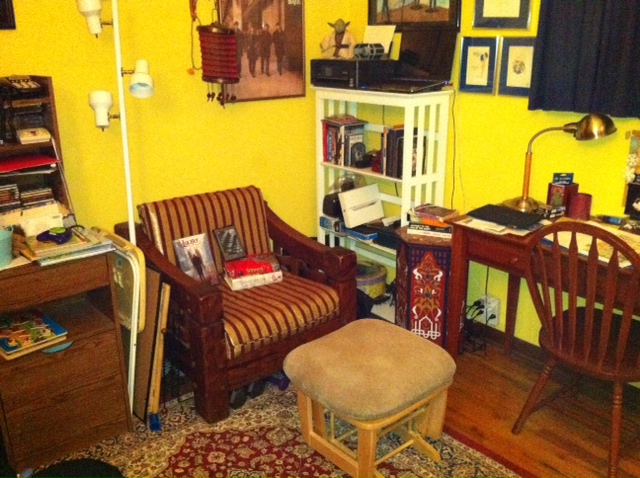
Life is tedious, stressful and noisy. I read for escape. Here’s my reading refuge:

my reading nook

My home office is one of my favorite places to read.

Where do you most love to read? I’d love to see pictures of your favorite reading spots.

Vacation envy

I haven’t traveled anywhere for vacation since 2003. I won’t bore you with the reasons why. Let’s just agree that I’m a bit overdue for non-work-related travel.

For the past week, I can’t log into Facebook without seeing tons of pictures of happy friends smiling on beaches. Friends toasting at nice restaurants and checking in from exotic locales. I don’t begrudge them their happiness. They are my friends. I am glad for them, but I think I liked it better in the old days when I didn’t get to travel vicariously along with all my globe-trotting friends in more or less real-time. The twinge of vacation envy wasn’t so sharp hearing about it after the fact, looking at a few dozen photographs and getting the distilled 10 minute travelogue.

I want my friends to keep having a great time. I want them to keep posting their pictures. What I want is a software solution so I can opt out of their happiness temporarily until I have steeled myself for the uncharitable thoughts and feelings that arise from involuntary vacation envy.

I want Facebook to install a photo filter that will automatically screen beach pictures from showing up in my news feed from the months of May through August. After that, I’m fine.

But, if Facebook is too busy dealing with its IPO fall-out and figuring out how to monetize the mobile Facebook experience, then I would settle for a third party solution. I’m picturing some sort of Facebook API that guarantees a vacation photo free user experience when I need it. Just something until the nerves settle and I resign myself to another year of not being at the beach and not being the smiling person toasting at some fantastic restaurant locale.

That shouldn’t be too much to ask.

I can’t be the only person who could use this.

More thoughts on Bergman’s “Two Lists”

I’ve spent the day thinking more about Bergman’s “Two Lists You Should Look at Every Day” post and realize I took the easy way out yesterday. The focus list of things I want to achieve is kind of a no-brainer. Of course, it helps to have a list of things that inspire me and carry me forward. That first list helps me better define my own understanding of success.

The second list is essential but far more difficult. Few people, Bergman claims, ever make the second list. The second list isn’t just a list of unpleasant or unimportant distractions to be avoided. The second list is hard because it may well contain things that are important, things that are worthwhile priorities, but which, I am consciously choosing to avoid.

What Bergman is talking about here is opportunity cost. For every opportunity I follow up on, I am trading the time and energy I might have made available for some other worthwhile opportunity. This isn’t an easy choice between things I like and things I don’t like. The second list involves guts. The second list involves disappointing people, letting things go, admitting my limits.

This second list strikes me as a very powerful idea. It actually scares me a little. I can’t quite get my head around it. I know I have a hundred things that belong on that second list but I don’t know how to start naming them.

Here is the generosity of Bergman’s suggestion: this isn’t a facile proclamation of what I want to do and what I don’t want to do. This is a public admission that, even if my talents were unlimited (they are not), my time and energy are finite. I can’t do everything I want to do or think I should do. I have to pick and choose.

The second list is about being mindful of one’s limits to avoid the trap of constant reaction. Our mobile, hyper-informed, web-laden lives are brimming with opportunity costs. Activities, projects and notions call for more than our attention. They call for our time. We cannot give them time without sacrificing time from somewhere else.

All of this brings me back to an idea I picked up a few weeks ago about reactionary workflow, the idea that our use of information technologies only make us more productive if we can harness them mindfully to accomplish specific things we wish to accomplish. Otherwise, we spend all our time reacting to other people’s agendas.

Success is spending time making the things you care most about. I’ve got to make these lists. I’m just not sure how to start.

Reading provides mental oxygen

Science fiction author William Gibson on how reading science fiction enriched his life:

Things might be different, science fiction told me, and different in literally any way you could imagine, however radical. Simply to know that people who thought that way existed was a game changer for me. Being able to directly access their minds, as a reader, was like discovering an abundant, perpetually replenished, and freely available source of mental oxygen.

Two Lists You Should Look at Every Morning by Peter Bergman

So, every now and then the universe throws a reminder flag and tells you to slow down and take a look. Today, that flag was “Two Lists You Should Look at Every Morning” by Peter Bergman.

Bergman reminds me that disciplined focus and mindfulness are more worth cultivating than simple information gathering and fast acting information reflexes.

There is skill in being able to define for yourself what kinds of activities are going to get your attention. How very much more powerful and useful to also be able to define for yourself what kinds of activities are not going to get your attention. It helps to call to mind the things that typically distract you and prepare yourself to move beyond those things.

I haven’t built my two lists yet. It does, however, call to mind my earlier post about the Stop Doing List, a mindfulness practice which I have not well-maintained.

Ah well. It’s a new week with new opportunities to do things differently or not do them differently.