Meeting Our Biological Selves

There are two kinds of experience that deliver immediate, intimate understanding of the rude facts of our biological selves: sex and the gastrointestinal virus. Warning: this post is not going to be about sex.

I have been carrying a stomach virus for four days. Today is the first day I feel reasonably good. When asked how I am doing, I sometimes say that I feel “almost human”. This is wrong. The feeling human part happens when you are alone in the bathroom at 3am and your body responds to needs completely independent of thought or ideation. The feeling human part happens when you are shivering underneath three blankets, feeling your joints shudder and shake with fever. The feeling human part happens when your guts speak in urgent susurrations, a wordless language that says everything it needs.

Not to be gross or vile. There is a kind of epiphany possible here. Especially if you are using the time that you are awake to reacquaint yourself with Ralph Waldo Emerson and the fine turns of thought possible from the mind well-refined. We elevate our minds. We prefer to think of ourselves as energetic beings of thought, insight and inspiration. We believe our minds carry us closer to the truth about God and divine purpose and original intent. And yet, in the same moment, our minds are tethered to our gross, rude, vulgar selves, the biological parts that are dirty, reflexive and tortured with appetites.

Most spiritual writing I have read posits these two realities in opposition. We are told that our spiritual selves are trapped in the animal prison of our flesh. And then, the Work becomes separating our spiritual selves from our biological selves. We spend our lives struggling against what we are in expectation that one day we will be made into something else.

Better perhaps to work with the dichotomy as it exists. There is much beauty in the knowledge that we are both. Not that the body is a flawed vessel that carries the perfect spirit, but that the body’s rude limits inform the spirit and teach struggle so that growth is possible.

If God created us, how perfect his design. To place pure idea, insight and reason into a sensing, experiential and irrational form. We are better for being in our biological bodies. Our biological selves prove that we belong to this life, to this world and to the universe itself.

Here is meditation to work with: Wretch. Be thankful. Wretch again. Understand. Amen.

Why TED Talks Matter

Yesterday’s post was about TED Talks as a platform for big ideas and John Spencer’s observation that, as a platform, TED Talks don’t leave much room for critique or response. TED Talks are idea packages, tailor-made to get an idea out into the world. They aren’t a platform for actually vetting those ideas and figuring out how and if they should be used. That kind of work happens someplace else. Or doesn’t.

I was captured by the plain truth of Spencer’s observation, but I can’t leave it there. Yesterday’s post was about what TED Talks are not. We need to talk about what TED Talks are.

I love TED Talks. The world needs TED and, I believe, the world is a better place for the kind of sharing that takes place there. TED is like a giant Enlightenment-era salon, where smart people get together and trade smart ideas and work to understand some kind of idealistic truth and then return to their daily lives feeling refreshed and inspired. That’s part of what TED is.

Today I watched Amanda Palmer’s talk about the art of asking. You should watch it. Her basic idea is that music companies (and presumably other media companies) should stop trying to figure out ways to force people to pay for music and, instead, figure out ways to allow people to pay for music. People love music. People connect to music and, by extension, their favorite musicians, on a deeply personal level. Those people want to pay to for music. You just have to let them. You have to know how to ask. It really is an interesting and inspiring talk.

Watching Palmer’s talk, I was struck once again by something very essential to the TED Talk experience. TED Talks are about storytelling and how stories connect people to ideas. Good stories do more than illustrate ideas. They create visceral, emotional connections to ideas, concepts and goals. Stories are how we get people to do things. Stories are how we get people to help us change the world.

My friend Daryl mentioned that TED Talks really are sales pitches more than they are lectures. He’s right. Maybe there are other places where big ideas go to get vetted and improved. Maybe the unique gift of TED presenters is their very powerful grasp of how story connects people to ideas and motivates people to want change. Maybe that’s what we need TED to be, a place to find stories that motivate and inspire us to want to change or try something new. Maybe TED isn’t really only about big ideas. Maybe TED is about connecting people to each other with story. If so, that may just be enough.

Poems Belong Everywhere

I love poems, but I don’t always particularly enjoy poetry.

I like the way a really good poem slices through the baggage of words and gets to the truth of things. I like the way a really good poem makes familiar objects seem unfamiliar. I like way a really good poem can surprise you, catch you off guard and force you to acknowledge beliefs you did not realize you held.

I love poems, but I have a terrible time with Wordsworth, Yeats, Keats and the crew. There was a time when I assumed that Eliot, Stevens and cummings spoke with ideas and a voice more rarified and brilliant than my own. I bashed my mind against their verse, trying to unlock their elevated ideas. It never happened, so eventually I stopped.

Then I started reading Kerouac and Ginsberg, Billy Collins and Mary Oliver and I began to understand poems again. Poems are a kind of meditation. Poems are moments of complete attention where the object and the subject disappear. Poems are acts of gratitude. Poems are declarations not of how things should be but declarations of how things really are. Poems are prayers.

Poems are useful. They have a purpose in every day life. The problem is, too often, poetry gets in the way of poems. Poetry makes poems into an abstraction, an idea of a thing rather than the thing itself. We teach ourselves to fear poetry in high school and then feel ashamed about that fear for the rest of our lives.

I particularly like the way Billy Collins puts it, “It is a good thing to get poetry off the shelf and more into public life.” His 2012 TED Talk shares some ideas on how this might work. I was particularly amazed by the animated poem mashup he undertook to bring 5 of his terrific poems to a new kind of life.

Take a look:

What do you think about the idea of poems in public life? Where does the world need poems? How can we get them there?

Kill the Main Character

I like stories where important characters die. Sometimes violently. Often suddenly. Always by surprise.

I am reading George Martin’s Game of Thrones series. I am deep into Book 4 and have lost count of the number of seemingly major characters who have died over the previous four books.

My favorite TV show of the moment is The Walking Dead. I just caught up with the first half of season 3. ***Spoiler alert: from the beginning of the show to the most recent episode, people die. Lots of them.

I grew up reading both horror and fantasy novels. I read both genres for years and then just stopped. My complaint with both genres was lack of surprise. No matter how unique the adventure, how bold the quest, how vicious the monster, you could rest assured that the hero would survive and overcome. Dull, dull, dull.

When you know the hero is going to survive, there’s really nothing at stake. I love the moment of frisson when a major character fails. The whole narrative spins. Every assumption about the rules of the story get reexamined. Everything is fresh and uncertain and the characters who remain get a lot more interesting because there are no guarantees. Everything is suddenly at stake.

This works best in stories of epic scale, tales with plenty of major characters to spare. But you can’t just stock the shelves with disposable bodies. You must first make me care about them. I need to relate to their motivation and root for them to succeed. Don’t let the death be entirely meaningless. The death should be quick and merciless. It should happen suddenly from an unseen direction, but it cannot be random and it must advance the story and increase the dramatic tension. The death must diminish the hopes of those who remain and then, inexorably,  force them to grow and inhabit their potential in unexpected ways.

Don’t write the same story over and over again. Invent new rules. Twist the old rules. Be brave. Force your characters to be brave. Kill your major characters. Don’t let the reader get too comfortable. I don’t read to be comfortable. I read to destroy my beliefs and unmake my assumptions. Surprise me. Don’t let me relax. Disturb me. I will thank you. I will read your books.

Nothing Special: A Meditation on Writing

451 words tonight. Not sure if they are good or bad, but they are out there now and the story has a new twist. To write about the mother, I need to write about the father. Both are such vile, loathsome creatures.

Writing is meditation and meditation is writing. Hold the seat with no gaining idea. Let the thoughts arise as they will. Observe them. Notice how the ideas dress themselves in words. Observe the words. Place them on the page. Let the words accumulate. Let them pile up in a gorgeous heap. Let them rise first to the knees, then the shoulder. Let them rise to the ceiling until you are buried in words. Let them rise until you are drowning, and you are unable to breathe. Then, stand back. Shake off the words. Remind yourself, no gaining idea.

Keep doing this. Not because the words are sacred. The words are not sacred. The words are mundane. Nothing special. Do this because words are nothing special. Keep doing this because the words are mundane.

Permission to Fail

This year, I am giving myself permission to fail. Actually, I am requiring failure. I expect failure.  I will be very disappointed in myself if I haven’t failed many, many times by the end of this year.

Failure is how we move forward. Failure is how

we learn and create new things. Failure is how we grow our experience and enlarge our abilities. Intelligence and talent are great gifts but success comes from the ability to

fail and fail well.

Failing well is about persistence and holding your seat when things are difficult. Anyone who wants to live a creative life eventually comes to realize that persistence is more important than inspiration.

Last year, I blogged about Neil Gaman’s 2011 New Year’s Eve Wish but the words are so powerful they are worth sharing again, one year later:

I hope that in this year to come, you make mistakes. Because if you are making mistakes, then you are making new things, trying new things, learning, living, pushing yourself, changing yourself, changing your world. You’re doing things you’ve never done before, and more importantly, you’re Doing Something.
So that’s my wish for you, and all of us, and my wish for myself. Make New Mistakes. Make glorious, amazing mistakes. Mak

e mistakes nobody’s ever made before. Don’t freeze, don’t stop, don’t worry that it isn’t good enough, or it isn’t perfect, whatever it is: art, or love, or work or family or life.

Whatever it is you’re scared of doing, Do it.
Make your mistakes, next year and forever.
Here’s to a prosperous, productive 2013 filled with failures that lead to discovery, insight and success.

failure_mother

Have we lost our nerve?

Today’s work commute podcast was Radiolab’s REBROADCAST: Space which originally aired August 20, 2012. Radiolab is always intriguing and definitely worth a follow. They ask big, baffling questions. This particular episode was devoted to comprehending the immensity of the universe, the insignificance of our place in that universe, and our perverse, yet oddly inspiring, quest to find the edge of space.

Turns out, we won’t. There is no edge. Bummer.

Actually, the best moments were the opening and closing segments. The opening segment describes the Voyager project, in which we launched a space craft bearing an auditory record of human civilization out into space headed away from us at 35,000 miles per hour. The artifacts on this craft were intended to accessible a billion years into the future. The Voyager craft is an invitation to visit Earth. Even if discovered by some intelligent alien beings, the odds that their civilization and ours will exist simultaneously are very small. We will likely be extinct before they get born. Bummer again.

The final segment talks about the loss of ambition regarding space travel that followed the tragedies of the Space Shuttles Challenger and Columbia. We don’t like the idea of people dying for space exploration. The problem there is that people will have to die. People always die when exploring new territory. Thousands of Europeans died when they sailed, explored and settled the West. That’s how it works. Thousands of brave souls flinging themselves at an impossible obstacle until, incredibly, someone makes it across. Here’s the difference: the thousands who died then died in isolation. The dozens who die now die on live television.

And so our governments now lack the ability to take the risks involved to do audacious things. We lack the ability to make sacrifice part of the recipe for solving immense problems. And so we are trapped on our planet, for now. Until someone figures out a way to make the necessary leaps without government help. It will happen.

Listening, I couldn’t help recalling the MIT Review article I recently reviewed which spoke to the same problem. We have, for the moment, lost our ability to imagine solutions to intractable problems. We have, for the moment, lost our nerve.

Crossing the Digital Rubicon: Am I Online or Offline?

This week’s On the Media podcast offers a fascinating segment about “What It Means to Be Online“. The piece cites a recent media survey by the Forrester Group which showed a decrease in the number of hours people report spending online. On the surface that might lead one to believe a digital backlash is underway, that people are finally tired of all their digital stuff and are setting their computers aside.

Not so fast. Turns out, people are spending more time than ever online. In fact, we spend so much of our lives online now that is getting hard for us to separate what is online time from offline time. A lot of the blurring stems from the vast amounts of time we spend online using portable devices. “Going online” is no longer an event, the way it was a few years ago. “Going online” no longer requires that one sit at a computer and dedicate time to searching, surfing or browsing the ways we used to. Turns out we spend vast amounts of time online without realizing or thinking about the time as being “online” because it blends so well into our regular routine.

Think about how many times a day you spend checking Facebook or Twitter on your smartphone. Or using Facetime or Google Hangout for a quick conversation. Or just sending a quick email to someone (maybe yourself) reminding them to do something.

Turns out we grossly under report the amount of time we spend online because online times blends so seamlessly into our daily routine. And it is only going to become more pronounced. Consider the blur that will happen when wearable, augmented-reality technologies like Google Glass become the norm and  our world is mediated through a digital filter. Pretty freaky stuff.

The author does a nice riff on William Gibson, the Matrix and Existenz. Really a great post. Well-worth your time to listen.

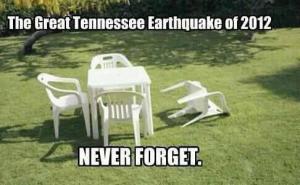
The Earth Moved (Just a Little)

The Earth moved today. Okay, the Earth actually moves everyday. Today I actually noticed it moving.

I was in my home office (Oak Ridge, TN), working on review notes for a friend’s article, when all the walls in the house began to shake. It was loud but not terribly frightening. It lasted only a few seconds.

At first, I thought the front of my house had been struck by a strong gust of wind, but I looked outside and none of the trees were moving.

Strangely enough, my first instinct was to post to Facebook and Twitter to see if anyone else had felt the tremor

While posting, my neighbor called to see if we felt the tremor. They had just had their pilot light activated and wondered if something had gone very wrong. We assured each other that we weren’t crazy.

A few seconds later the tweets and Facebook posts started rolling in. Friends felt it from miles away. Turns out a large part of the South

Fascinating to see so many people reach for Facebook to share the experience or just confirm sanity.  Equally fascinated to get a tweet from a friend in Nashville who didn’t feel the tremor but had seen a news article tweeted a few moments before.

This is how news travels now. We turn to Facebook to make sure our people are okay and Twitter provides the information on what’s going on.

A completely minor, non-event. Still, a nice, gentle reminder that it’s all connected.

Things Fall Apart. Be Brave. (A Meditation)

I am one of those people who needs to constantly reinvent and try new things. I am a project-minded person and think of my projects in terms of building the future. I often find it easy to be brave when building new things.

Less easy for me to be brave when the things I build fall apart. It is the nature of things, once built, to eventually fall apart. This is dharma. This is the reality of things.

The truth is Things are in a constant state of becoming what they will be. Building them is only part of the becoming. The future doesn’t only happen when we build. More often, the future arises when things fall apart. If we are ready, there is tremendous room for surprise and creative action when things fall apart. 

Letting things fall apart requires courage. Be brave. We don’t only build things. We sometimes have to let them come apart.