While the Iron’s Hot

I’m not in a position to teach anyone how to be a successful writer, but I can share an experience that corroborates advice I have often been given but somehow never managed to accept.

A few weeks ago, I had a great idea for a story. I started to work right away. I couldn’t not work on it. I had to do the work. It didn’t matter if the story was coming out left, right or upside down. I just needed to get the words that were inside moved to the outside. Things were going well. Words were piling up, and the story was moving forward.

Then I got sick. Then work got busy. Then I got frustrated. I lost the story.

The story is still there. I still intend to write it, but the urgency is gone. It bled out in those few quiet days when I was not writing. The story was happening. It was real. It was urgent. And then it was gone.

When you start a piece of writing, start it quick. Don’t think too much. Don’t ponder or plot too long. Don’t hit the snooze bar in the morning, and, for God’s sake, don’t stop.


Year of Writing Dangerously by Barbara Abercrombie (book review)

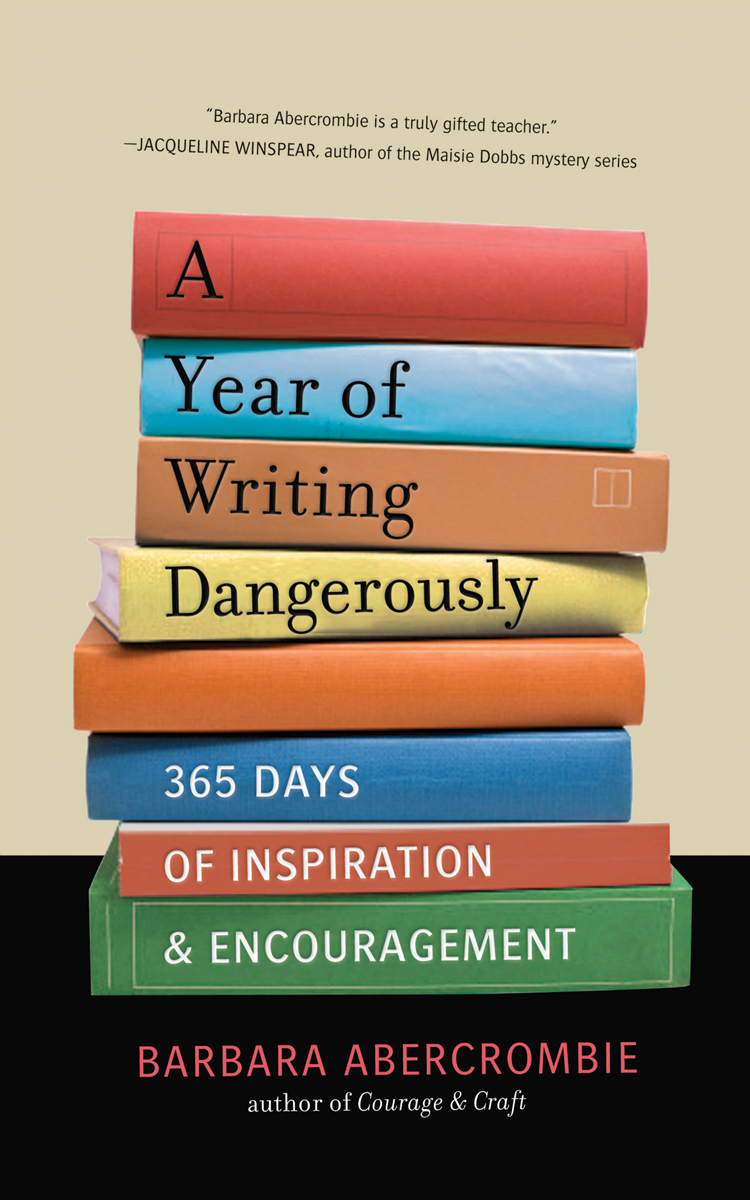
This blog was never supposed to be about writing. Still, I  have been thinking and writing a lot about writing lately. This blog has put me in touch with a community of people are also thinking and writing a lot about writing. We are always seeking inspiration, communion and support. To those friends, I recommend Barbara Abercrombie’s Year of Writing Dangerously: 365 Days of Inspiration & Encouragement

As the title suggests, it is basically intended as a year-long writer’s toolkit for inspiration. I read it in 3 days. The entries are short — one or two pages for each day. Abercrombie provides practical, encouraging advice for writers. She does not pander or become too precious. She appreciates that writing is a struggle but doesn’t get wrapped up in the romance of that struggle.

She offers great quotes and stories from effective writers from across time. She blends their advice into a few basic tennets:

  • People who want to write better or write professionally must write every day.
  • Writers must read a lot.
  • Writers need a support network of disinterested peers who can criticize in a positive, ruthless manner.
  • Family members should not read what we write until the work is published and it is too late to turn back or make changes.
  • The best writing results from taking bad stuff out more than from adding good stuff in.
  • Unfortunately, it is as difficult to write a really bad book as it is is to write a really good book.
  • Always finish. Unless you can’t. Then don’t finish.
  • Find your process and stick with it. What works for others may not work for you. There is no recipe.

abercrombie-final.inddThe appendix offers the gift of 52 writing prompts to unstick stuck writers. They are pretty good.

Just a few pages into the book made me feel like writing. If you write or spend lots of time thinking about writing, you will enjoy this book very much.

Familiar Faces, Unmet Friends

Twenty years ago, I had a dream that has stayed remained with me. I don’t often remember my dreams. When I do, they feel important so I pay attention.

In this dream, I am wandering the halls in a big, empty house with no furniture. I come to an open door and enter a large room. The room is crowded with people and creatures. Many are mundane. Some are fantastic. I have never met these people, these creatures, but they recognize me, and they are glad I am there. They smile and make me feel welcome.

I woke from that dream feeling like this was a roomful of not yet imagined characters, relieved to be finally discovered. They were glad and patient. No one spoke. They just smiled and nodded, as if they had all the time in the world.

I was thinking about this dream after writing this morning. I was working on a piece of improvised fiction from a prompt. The writing itself didn’t go especially well but I was struck by how much fun it is to write sometimes and find entire people living inside you with their own thoughts, feelings and ideas about things that seem quite separate from you. It is a powerful feeling to discover these other lives inside of you, unseen and unobtrusive, waiting for their turn to be discovered through words. Just like that roomful of unmet friends from twenty years ago.

This is a very powerful feeling that arrived like a gift. This is a happy reminder of why I ever bother writing at all.

Writing at 6AM

I woke up early this morning to start writing. It is still dark outside. The birds are just now starting to sing. I have no idea what I’m doing or why I am doing it. I had the thought that writing might be easier first thing in the morning, and that I might sneak my way back into the story by jumping into it fresh from last night’s dreams. A bit like ledge jumping from one roof to another. I didn’t make the leap.

194 words. None of them particularly interesting or useful.

I am not complaining. I only want to document that this moment happened. I woke up at 6am. I got dressed. I started writing. I was here. I understand that this is how this works.

More Than Content

I have been thinking about Jim Rettew’s comments about the Idea Industry and how treating ideas and inspiration as commodities limits how we can interact with and use those ideas.

The Idea Industry is way bigger than TED. It includes writers like Jonah Lehrer and Malcolm Gladstone, podcasts and, yes, bloggers.

As one of those bloggers, I sometimes wonder what it is I am actually doing when I write for other people to read. Am I just moving ideas around from place to place, pointing to interesting sites that others might find inspiring or, at least, amusing for a short while? Or does my work as a blogger contribute something greater?

We often talk about blogs and books and articles and movies as content, as if it were something physical that resides inside something else. A specific, discrete something with its own properties than can be placed in a vessel, carried somewhere else and then transferred to another vessel. That is the connotation of content. In this model, art is about information transfer.

Blogs and books and articles and movies can be more than just content. Content is information. If blogging is just about information transfer then it is easily done and pretty much anyone can do it.

My best blog posts, the one’s that get comments and get people interested, are the posts that tell stories. Good blog posts share something from personal experience and connect it to the experience of other people. That is what we can do here to add value. We can tell stories. We can tell stories about ourselves, people we know and people we invent. We can tell stories as a way to connect insights to experience.

Come to think of it, this is what great teachers do, too. They move beyond lecture and tell interesting stories to help students make their own insights.

Come to think of it, this is what Jesus and Buddha did. They didn’t lecture or preach a lot. They pretty much went around telling people interesting stories that connected ideas to experience. That’s how major movements get born.

The way we think about what we do determines the value of what we do. If we trap ourselves into the act of creating content, that is all we will ever have to offer. We can offer more of ourselves and help make the best ideas come to life.

We can tell stories.

Flash Fiction: Sometimes Writing Feels This Way

A quick work of flash fiction. Tried to write something very different tonight. This came out instead.

*****

Harold had no idea what time it was or exactly how long he had sat staring at the empty white field on his screen. She was gone. He had no idea how long she had been gone. It felt like weeks. He hadn’t heard her go. There was no final closing of the door, no last flip of the switch. She had been there when he was not paying attention and now she was gone.

Harold thought about getting up to look for her. It would do no good. He had called her name five times already, each time expecting her to bound into the room with an offer of help. The right word. Some lascivious whisper. One delicious sentence to get him started.

There would be no more of that. She was gone.

The screen was blank. His eyes ached from the glare. Was he watching the screen? Was the screen watching him? It was hard to know which was which.

He hadn’t heard her go. How long ago had she left? He felt like he should still be able to catch her scent in the room. There must be some trace of her perfume, some phantom tendril to remind him of her. She wouldn’t have been gone that long. She wouldn’t have left him completely empty. She would have left him with something with which to remember her.

He looked around the room, confused and crippled feeling from his time spent hunched over the chair.

Had he slept? Impossible that she had left while he was staring at the screen, not writing. He must have fallen asleep. He must have slept.

Harold pushed away from the desk. He was trying to remember the last thing she had said to him. What had it been? Was there some clue contained inside?

I’m going out. He could certainly imagine her saying that. He could hear the words in what he believed to be her voice. I’m going out. So casual. So normal. She was going out, just like had a hundred times before. She would be back. That was how it worked. She went out then she came back. He tried to satisfy himself but the words sat false. That was not what she had said.

Harold stood up, unsteady on his feet. He was drunk with exhaustion. It was hard to keep himself steady. He walked across the bedroom, ready to grab for balance if needed. The room was moving around him.

The bedroom door was open, a mouth open to the long dark hall beyond. Seeing it made him panic. He had not left the door open. He always closed the door when he was writing. Or not writing. She had opened the door. She had left the door open.

He thought of calling her. Certainly not the first time he had thought of that. The idea was no good. She didn’t have a phone.

What kind of person these days doesn’t carry a phone?

Harold shuffled down the long, dark hallway, feeling like a person in a horror film about to stumble across the dead body. And it would have been some kind of relief for him to find her lying there. Then he would not need to know that she had left him and was not coming back. Dead was better. If she was dead, that was one thing. But she wasn’t dead. At least, she wasn’t dead in his apartment, and Harold was left alone once again with the more awful truth.

She had left him. He had not heard her leave. She was not coming home.

Creative Advice from Ira Glass

I have been writing off and on for 24 years. I’m not really sure why I do it. Sometimes I write because I feel like I have to. Sometimes I write because I feel like there are stories stuck inside of me. Sometimes I write because I have ideas in my head that I don’t really understand and I want to understand them better.

I take writing pretty seriously. I stress out about writing. I talk about writing. I read about writing. I pretty much obsess about writing. The one thing I don’t do enough, it turns out, is actually writing.

The writers I admire most say that the secret to being a great writer is writing everyday. Just writing and writing and writing. It makes sense, but it isn’t particularly encouraging advice when the writing feels so thin and poor on the page.

Ira Glass says that’s normal. In fact, mediocrity is part of the process. All good artists start out being mediocre and they are dissatisfied by their own mediocrity. This dissatisfaction dissuades most people from sticking with it. Don’t give up. The cure for mediocre art is to create lots and lots of mediocre art. The fact that you recognize your own art’s mediocrity is a sign of good taste. Keep working at it. Work at it for years. Slowly, you will close the gap. Someday, your art will be as good as your taste, but only if you stay with it and only if you do it a lot.

Here’s how Ira Glass says it:

Keep doing it.

Poems Belong Everywhere

I love poems, but I don’t always particularly enjoy poetry.

I like the way a really good poem slices through the baggage of words and gets to the truth of things. I like the way a really good poem makes familiar objects seem unfamiliar. I like way a really good poem can surprise you, catch you off guard and force you to acknowledge beliefs you did not realize you held.

I love poems, but I have a terrible time with Wordsworth, Yeats, Keats and the crew. There was a time when I assumed that Eliot, Stevens and cummings spoke with ideas and a voice more rarified and brilliant than my own. I bashed my mind against their verse, trying to unlock their elevated ideas. It never happened, so eventually I stopped.

Then I started reading Kerouac and Ginsberg, Billy Collins and Mary Oliver and I began to understand poems again. Poems are a kind of meditation. Poems are moments of complete attention where the object and the subject disappear. Poems are acts of gratitude. Poems are declarations not of how things should be but declarations of how things really are. Poems are prayers.

Poems are useful. They have a purpose in every day life. The problem is, too often, poetry gets in the way of poems. Poetry makes poems into an abstraction, an idea of a thing rather than the thing itself. We teach ourselves to fear poetry in high school and then feel ashamed about that fear for the rest of our lives.

I particularly like the way Billy Collins puts it, “It is a good thing to get poetry off the shelf and more into public life.” His 2012 TED Talk shares some ideas on how this might work. I was particularly amazed by the animated poem mashup he undertook to bring 5 of his terrific poems to a new kind of life.

Take a look:

What do you think about the idea of poems in public life? Where does the world need poems? How can we get them there?

An Open Letter to the Muse

You won’t have noticed this, but I have been sitting at this desk off and on all day, wanting to write something. Nothing profound. Nothing special. Just the pleasant flow of words through fingers and keys then onto the screen. I’m not sure what I had wanted to say. Even now, writing this, I’m not sure what I want this to say.

I am wondering why you can’t stay put. Or, if you really must wander, why you can’t be someplace I can reach you when I am ready. You could leave a number that I could call when necessary.

Where do you go when you aren’t here with me? Is there someone else, some other writing person who is smiling even now, getting words on his screen? Is he getting my words? Is that what’s happening?

I don’t want to sound small or jealous. That isn’t me. It just isn’t right for you to sneak off that way and leave me alone and a little bit afraid that I may not write again.

We have a good thing, don’t we? I mean, I know I get busy and a little distracted. Maybe sometimes a few days goes by before I sit down in our place to feel the words. Maybe sometimes I rush things a little or simply go through the motions to get the time in, not really present, not really participating.

I can do better. Sure. I know I can. But so can you. Where are you? Where did you go? Why are you always running away when I have time to write and then hanging close when I have no time at all?

You are a fickle creature. I deserve better.

I’m sorry. That last thing was wrong. You are right to go. I don’t deserve you. I’m just glad to have you in my life.

Where are you? When are you coming home?

The first line

Two takes from a prompt: “What is your metaphor for the fear of writing that first line?”

*****

Take one:

The first line contains the entire story. It is everything. Once the first line is written, everything else is inevitable. The entire story unlocks itself in your head. And you are stuck with it. You have to do the work. You have to set it down on the page or it will grow inside of you and press against the inside of your skull and make you sick with inspiration. Sick and angry and agitated, dangerously altered and off-kilter. Once the first line happens, the rest of the story leaps up inside you, fully formed if only partly seen.

Once the first line escapes your head, you have only two choices: swallow it down or vomit it out.

Take two:

They are lying in bed, unclothed, not speaking. Sunlight spills in through the curtains, filling the bedroom with a holy light. They are waiting. The sound of their tandem breathing excites him. He is eager to veil her face with kisses. He does not move. Not yet, he tells himself. Say something clever.

She shifts slightly under the covers while he is thinking. The rustle of her bare legs beneath the sheets piques exquisitely.

Not yet, he tells himself. Too soon. This is not yet enough, he tells himself. She is only just shifting to make herself more comfortable. He wants to help her writhe.

The sound of their breathing, an anticipatory rhythm gradually cooling until it becomes a thing between, a thing that separates them.

And now he stares up at the ceiling, mind reaching for words. Say something brilliant. Say something devastating. There is nothing.

And now he begins to panic. This perfect moment is tilting away from him. Two bodies, familiar and eager, caught in an uncomfortable space, trapped by thoughts and ideas. He is captured inside his mind and he can only look out at her through the narrow turrets of his eyes and see her there waiting, wondering what is taking so long. A moment ago she had been perched on the precipice of pleasure, a women ready to dive down headlong. Now, she was a woman waiting for a bus. A woman of great restraint, assiduously not checking her watch. A woman with places to be.

Say something, his mind screams. Say one simple thing to set this into motion. The words all scramble away from him, darting and scattering like a school of tiny fish.

She rolls over onto her side. They lock eyes. He is no longer staring at the ceiling. His mind no longer reaching for words.

“I’m right here whenever you are ready,” she tells him and he realizes in that moment there is nothing that needs to be said. He reaches out for her. His fingers find her skin. There are no words that need to be found. There is nothing he should do to improve this moment.

He is there. She is there. This is the first line. Their bodies know exactly what to do.