Crossing the Digital Rubicon: Am I Online or Offline?

This week’s On the Media podcast offers a fascinating segment about “What It Means to Be Online“. The piece cites a recent media survey by the Forrester Group which showed a decrease in the number of hours people report spending online. On the surface that might lead one to believe a digital backlash is underway, that people are finally tired of all their digital stuff and are setting their computers aside.

Not so fast. Turns out, people are spending more time than ever online. In fact, we spend so much of our lives online now that is getting hard for us to separate what is online time from offline time. A lot of the blurring stems from the vast amounts of time we spend online using portable devices. “Going online” is no longer an event, the way it was a few years ago. “Going online” no longer requires that one sit at a computer and dedicate time to searching, surfing or browsing the ways we used to. Turns out we spend vast amounts of time online without realizing or thinking about the time as being “online” because it blends so well into our regular routine.

Think about how many times a day you spend checking Facebook or Twitter on your smartphone. Or using Facetime or Google Hangout for a quick conversation. Or just sending a quick email to someone (maybe yourself) reminding them to do something.

Turns out we grossly under report the amount of time we spend online because online times blends so seamlessly into our daily routine. And it is only going to become more pronounced. Consider the blur that will happen when wearable, augmented-reality technologies like Google Glass become the norm and  our world is mediated through a digital filter. Pretty freaky stuff.

The author does a nice riff on William Gibson, the Matrix and Existenz. Really a great post. Well-worth your time to listen.
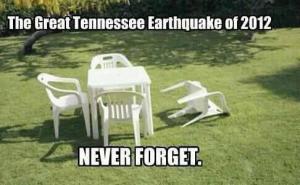
The Earth Moved (Just a Little)

The Earth moved today. Okay, the Earth actually moves everyday. Today I actually noticed it moving.

I was in my home office (Oak Ridge, TN), working on review notes for a friend’s article, when all the walls in the house began to shake. It was loud but not terribly frightening. It lasted only a few seconds.

At first, I thought the front of my house had been struck by a strong gust of wind, but I looked outside and none of the trees were moving.

Strangely enough, my first instinct was to post to Facebook and Twitter to see if anyone else had felt the tremor

While posting, my neighbor called to see if we felt the tremor. They had just had their pilot light activated and wondered if something had gone very wrong. We assured each other that we weren’t crazy.

A few seconds later the tweets and Facebook posts started rolling in. Friends felt it from miles away. Turns out a large part of the South

Fascinating to see so many people reach for Facebook to share the experience or just confirm sanity.  Equally fascinated to get a tweet from a friend in Nashville who didn’t feel the tremor but had seen a news article tweeted a few moments before.

This is how news travels now. We turn to Facebook to make sure our people are okay and Twitter provides the information on what’s going on.

A completely minor, non-event. Still, a nice, gentle reminder that it’s all connected.

A Tweetable Mission Statement

Things get crazy and it gets hard stay focused. When there is too much to do, prioritization becomes essential. Prioritization isn’t easy. Everything feels urgent. Everything feels important.

Personally, I struggle a bit with prioritization. I have often read that the core of good time management practice is having a clearly stated personal mission statement. A personal mission statement isn’t a description of the work you do. A personal mission statement is a statement of what you intend to accomplish through the work you do. The mission helps you determine the work. Not the other way around.

I have taken a few passes at a personal mission statement, understanding that this should evolve over time. I recently realized that the frustration I felt at not grasping and attaining clarity with my personal mission was that it had become overly complex. I explained too much.

So here’s my new rule. My personal mission statement must be tweetable, 140 characters or less.

Here’s where I am today:

Be curious and inspire curiosity in others. Learn new things and make it easier for others to learn. Help people share what they learn.

24 words. 135 characters. It explains why I am a librarian. It explains why I get myself involved in things that matter. It explains why I read, write and share ideas. I can’t claim to have realized this goal but I can say it is helping me find clarity of purpose and a little sanity in the ways I choose to divide my time.

Hyperbole kills: Tech advertising limits ability to solve problems

Random juxtaposition of ideas is often, for me, the Web’s most useful gift. Consider this: last night I watched this satirical video about Apple’s iPad mini:

and then 20 minutes later read this really insightful article from MIT Technology Review about “Why We Can’t Solve Big Problems”.

You should enjoy both for yourself. The idea that sparked for me was the false expectation that each generation of Apple stuff be revolutionary, innovative or game-changing. We should place a moratorium on these words when talking about technology.

A faster processor is not revolutionary unless it allows us to do something we couldn’t even think about before.

Better screen resolution isn’t innovative unless it makes things visible that were not visible before. It just makes things look prettier. Prettier is good. Prettier is worth paying for. Prettier isn’t necessarily innovative.

If I were a person who carried things in a purse, I might be tempted to consider a smaller iPad as being game-changing. But only if it meant I could use my iPad in novel situations where I could not previously use it.

I love my iStuff. Desperately and truly. I just happen to believe that Apple is guilty of the kind of advertising hyperbole that diminishes our collective ability to imagine the ways great technology might help actually solve huge, intractable problems.

I’m am so glad to have smartphones, Twitter and streaming video service enriching my daily life. Where are we with world hunger, climate change and space exploration?

Unscripted time

A friend at work recently congratulated me on becoming the “man with the most hats in the world”. I’m still trying to figure out if this was a compliment or something else. Either way, she is right. I am currently wearing a lot of hats. Trouble is, I still only have one head.

There is no end to the urgent, imperative, interesting work that begs to be done. I can count at least 7 major projects/initiatives with significant claims on my time and energy. Each deserves my fullest focus and effort. Each will get the absolute best that I can deliver.

I took a few days off this week to rest a bit and refocus myself before things get really crazy.  Much of this time I was busy at my mom-in-law’s house, getting it ready to put on the market. The work was tiring but rewarding and productive. Sometimes it is invigorating to work hard at something other than what you normally do.

This afternoon I found myself with a few hours unscripted time, no commitments or plans. I wasn’t  passing out exhausted. My daughter was at her grandmother’s house. I read a book. I listened to music. I let my mind wander. I felt good.

This is just to remind myself that we don’t always accomplish the most by dumping tons of hours in toil. Sometimes, we have to make space for ourselves by allowing room for unscripted time. Time that belongs to us without expectation of what we will produce with that time.

I feel refreshed. I feel focused. I feel ready. I do have many hats to wear. I once again believe I have enough heads to wear them all.


More Thoughts on Opportunity Cost

Last night’s post on opportunity cost missed the point. Technology doesn’t create or increase opportunity cost. Our technology makes us hyperaware of opportunity costs in real time.

Last night’s post dwelt a bit too much on the fear of missing out on social things — trip to the beach, dinner at a restaurant. Guess I was feeling a bit sorry for myself. For me, this isn’t about social anxiety or jealousy. It is about how I manage the information flood.

Examples:

  • every minute spent on Facebook on my smartphone while standing in a room with people is a moment not spent talking to people standing with me
  • following comments and links of professional interest on Twitter limits the time I can spend doing the same on RSS feeds, Zite and Scoop.it.
  • writing a blog post means fewer minutes reading that great book
  • catching up on email during a few unbusy moments means having fewer unbusy moments to reflect and see what’s happening around me

You get the idea. The point isn’t that these things are bad. The point is that it is getting more difficult to decide how to spend/not spend my time. I can’t escape the choices.

The choices aren’t new. They have always been with us. Now, we get to see opportunity cost up front. It isn’t so invisible. That is why so many people, self included, find the Social Media/Information Age a bit overwhelming and anxiety-inducing. I haven’t yet mastered the skill of disciplined focus. I haven’t yet mastered the skill of opportunity selection.

These are the skills we need to survive and succeed.

Getting Comfortable with Opportunity Cost

There is a particular kind of anxiety that can come with being Constantly Connected. Natalie Houston describes it well in her Prof Hacker post “Are You Missing Out?” in which Houston explores the anguish du jour: Fear of Missing Out.

I get it.

Facebook, Twitter, Instagram, Foursquare, and Pinterest make us instantly aware of what our friends are doing right this moment. That’s kinda nice. The downside: being constantly aware of what my friend are doing becomes constant awareness of what I’m not doing. I’m not at the beach. I’m not at the concert. I’m not eating at the restaurant. More interesting than this petty jealousy is the resulting compulsion to share the trivia of my life so I can participate in the What I’m Doing machine.

Nothing wrong with this in doses. Unchecked, it can make a person neurotic.

Which brings me right around to something I’ve been wrestling with lately. With iPad, iPhone, iPod and social media, I have superhuman powers to communicate, participate and share with the entire world. Literally. I am more well-informed and better positioned to have real influence than ever before. Because of this reach, I am being stretched in more directions than ever before.

I can see for miles in every direction but can’t always seem to easily focus where my attention is most needed. Focus takes effort.

Focus, I think, will become the defining trait of personal and professional success in my years ahead. Time to start practicing the art of applied vision, truly seeing where I look. This is the principle of opportunity cost. Every accepted opportunity limits the ability to pursue another, different opportunity. Our reach is not infinite. I can’t do everything. Time to stop thinking so much about what I am going to do and start marking the harder, more rewarding choices about what I am going to intentionally miss out on.

Pay Attention. This Isn’t My Life.

There have been plenty of times I have thought to myself: this isn’t my life. My life isn’t the 45 to 50 hours I work every week. My life isn’t the stuff I do around the house or the trips to the grocery store. My life isn’t my Wunderlist website of long term projects or the daily Stky list of tasks I keep on my phone.

My life is the thousand beautiful moments happening every day, which I am usually too busy to notice.

Occasionally, my life leaps out and grabs me by the throat.

Today my life caught me by surprise. The trigger was a cataclysmic sunset, both beautiful and terrible, like the  edges of the world caught fire. This, like a poem, grabbed me and could not be ignored. I turned the car around to admire the conflagration and, too soon, it was gone.

Memories of another fleeting sunset while listening to Stevie Ray Vaughn play “Little Wing”. This is my life: small, subtle moments of profound beauty where the world is simultaneously made and unmade. Reaching out to capture me, when I pay attention.

Things Fall Apart. Be Brave. (A Meditation)

I am one of those people who needs to constantly reinvent and try new things. I am a project-minded person and think of my projects in terms of building the future. I often find it easy to be brave when building new things.

Less easy for me to be brave when the things I build fall apart. It is the nature of things, once built, to eventually fall apart. This is dharma. This is the reality of things.

The truth is Things are in a constant state of becoming what they will be. Building them is only part of the becoming. The future doesn’t only happen when we build. More often, the future arises when things fall apart. If we are ready, there is tremendous room for surprise and creative action when things fall apart. 

Letting things fall apart requires courage. Be brave. We don’t only build things. We sometimes have to let them come apart. 

Future orientation

I have had some recent life experiences that have allowed me to reflect a bit more deeply that usual on who I am and how I view the world. I am strongly future-oriented. This serves me very well in my role as a library administrator. I am often able to imagine what services and resources are likely to be needed tomorrow so I can start building them today. This is nice gift to have. It keeps me enthusiastic and creative. It keeps me moving forward.

The problem with future-orientation is that I often feel like I can see the future more clearly than the present. More to the point, if I am not careful, I can easily spend more time and energy looking at the future than I do the present. This can lead me to see the big picture quite clearly but miss the thousand essential details that make up today. So I need people around me who can help me be mindful of what needs my attention today. And I need people around me who can be patient with my tendency to leap forward before I walk back. And I need people around me who appreciate the beauty of ideas and know that not every thing I say aloud has to become instantly true. Not every project has to get born. We can negotiate. We can prioritize together. But we have to move forward. Sometimes we move quickly. Sometimes we move slowly. We have to be always moving forward.

I am grateful for the people in my life who recognize this aspect of my nature. I am grateful when they appreciate this way of seeing. I am grateful when they can help me to be mindful and pay attention to things as they are today. I am grateful when I am able to make this way of seeing useful. I am grateful for the people who connect my ideas to reality and use them to move things forward.