Kill the Main Character

I like stories where important characters die. Sometimes violently. Often suddenly. Always by surprise.

I am reading George Martin’s Game of Thrones series. I am deep into Book 4 and have lost count of the number of seemingly major characters who have died over the previous four books.

My favorite TV show of the moment is The Walking Dead. I just caught up with the first half of season 3. ***Spoiler alert: from the beginning of the show to the most recent episode, people die. Lots of them.

I grew up reading both horror and fantasy novels. I read both genres for years and then just stopped. My complaint with both genres was lack of surprise. No matter how unique the adventure, how bold the quest, how vicious the monster, you could rest assured that the hero would survive and overcome. Dull, dull, dull.

When you know the hero is going to survive, there’s really nothing at stake. I love the moment of frisson when a major character fails. The whole narrative spins. Every assumption about the rules of the story get reexamined. Everything is fresh and uncertain and the characters who remain get a lot more interesting because there are no guarantees. Everything is suddenly at stake.

This works best in stories of epic scale, tales with plenty of major characters to spare. But you can’t just stock the shelves with disposable bodies. You must first make me care about them. I need to relate to their motivation and root for them to succeed. Don’t let the death be entirely meaningless. The death should be quick and merciless. It should happen suddenly from an unseen direction, but it cannot be random and it must advance the story and increase the dramatic tension. The death must diminish the hopes of those who remain and then, inexorably,  force them to grow and inhabit their potential in unexpected ways.

Don’t write the same story over and over again. Invent new rules. Twist the old rules. Be brave. Force your characters to be brave. Kill your major characters. Don’t let the reader get too comfortable. I don’t read to be comfortable. I read to destroy my beliefs and unmake my assumptions. Surprise me. Don’t let me relax. Disturb me. I will thank you. I will read your books.

Leading is About Courage

I have become very mindful of my growth as a leader. I run an academic library. I have been given additional, interesting administrative experiences at my college. Incredibly, there are people who trust me and seek my opinion. It is all very humbling and makes me grateful for the generosity of the excellent people who have mentored me over the past 20 years.

I am thinking of the high school teacher who encouraged me to pursue my weird passion for learning new things and to share that weird passion with others.

I am thinking of the boss at my first job who didn’t berate me when I made a huge mistake and, instead, helped me work out my own plan for correcting and preventing such mistakes in the future.

I am thinking of the college administrator who let me dream big and fail big, testing and discovering the limits of personal ambition.

I am thinking of the colleague who constantly encourages me to look forward, move forward and engage with change in a positive, proactive way. That is the only way we can shape the future.

All of these people have, in their own unique way, taught me one valuable lesson: leadership is about courage — having courage and lending courage.

Every team has a leader. Sometimes that person is officially paid to be the boss. Sometimes that person is the leader by default. I have worked both ways. In either case, there is always a leader and the members of the team look to that leader for confidence. A leader demonstrates confidence by clarity of vision, simplifying complexity and acting with consistency in changing circumstances. A leader acts with confidence and models courage. This is essential but also pretty basic.

As a leader grows, he or she is able to not only have courage but lend courage to others. Courage to try something new. Courage to sit with a problem and figure things out. Courage to voice unpopular opinions. Courage to accept responsibility. Courage to fail.

Nothing useful happens on a team that has no courage. No matter how much intelligence, experience, and vision is tied up in a team, nothing worthwhile happens without courage.

This is the lesson I work with everyday. I work to keep myself mindful and worthy of the example of those who have invested their trust and confidence in me. I struggle. I fail. I disappoint. I hope I also give courage where courage is needed.

The world is a difficult place. Everything is in flux. Nothing stays still. A leader’s job is to keep everyone moving bravely forward. We can accomplish nothing when locked up in fear. There is an openness and a lightness that comes when working with courage. When that courage is shared, there are no limits on what can be accomplished.

A Thoughtless Gift, More Personal than Cash

My friend Daryl turned 40 yesterday. I gave him an Amazon gift card. My mother turned <redacted> last week. I gave her an Amazon gift card. I gave my youngest brother and my dad Amazon gift cards for Christmas. I am pretty sure I also gave my dad an Amazon gift card for his birthday in October.

I admire people who possess the talent for gift-giving. Some people have an eye for the perfect token of admiration, that small, specific little something that stands as evidence of attention to the friendship. I am not one of those people.

I’m not lazy. I want to give the right gift. I want the gift to be meaningful. I want the gift to be interesting and valued and evoke some special memory in the recipient years later. I want the gift I give to do all these things, but, most of all, I want my gift to be useful.

I used to think that giving gift cards was the least thoughtful gift a person could give. A gift card was an admission of failure, an acknowledgment that I could not find anything suitable in the amount of time I gave myself to look for that special token. Just barely more personal than giving someone cash, which, back in the day, meant you hadn’t even bothered to leave your house.

Of course, these days, if I gave someone cash, it means I made a special trip to the credit union or ATM since I never carry cash.

I often give Amazon gift cards but feel a bit conflicted every time. I like Amazon gift cards. They are useful and valued and allow purchase of interesting things. I give Amazon gift cards because they allow a person to get whatever they want and not have to suffer covert trips through the Walmart return line in the middle of night. I give Amazon gift cards because I like getting them. I like having credit in my Amazon and iTunes accounts which can be used at a moment’s notice.

Still, I often worry that others might feel I am devaluing the relationship, that somehow the Amazon card represents a shortcut in our friendship that bespeaks a laxness or lazy inattention.

I worry too much it turns out. My friend Daryl got at least 5 other Amazon gift cards. Every single card he opened had a card from Amazon. It was like opening a treasure chest of virtual goods. He was happy. I was happy. If my gift was the lazy fruit of thoughtlessness, then everyone else was lazy and thoughtless too.

Instead, I realized an important truth. Amazon and iTunes gift cards are the new social currency. We don’t give gifts as much anymore. People don’t really need or want stuff. So, instead, we give them little pieces of plastic that represent a kind of pretend money which they can use, if they want, to purchase invisible goods.

Daryl probably has a long list of nifty things he plans to buy. Some of them are probably visible. He is a great collector of books, games and other interesting things. As for me, I collect invisible things — music, eBooks, apps. On birthdays and holidays, I hope for the little envelope with the Amazon or iTunes card inside. It saves me a trip to the store to convert my cash into single-store credit. This is the new economy. I don’t want money unless it is the kind I can spend easily at Amazon or Apple.

What do you think? Are gift cards a cop out or a super-thoughtful way to say you care?

Meditation: Your Life is a Borrowed Thing

Your life does not belong to you. It is a borrowed thing. Someday, you will be required to give it back. Until then, you must use your borrowed life as an instrument. Do good work. Contribute everything you can. Hold nothing aside. Increase happiness. Help others make the most with their borrowed lives. Learn without fear. Help others learn without fear. Be relentlessly generous. Give until you have nothing left. This is how you live the kind of life worth living. This is how you honor the gift you have been given. This kind of life does not come easily. Practice everyday. Do not tell others how they should live. Show them. Prepare the way for those who come after you. Return your life when it is required of you. Stand aside. Smile. Breathe.

(for JT)

Having Power vs. Giving Power: Leadership Lessons from Dr. Martin Luther King, Jr.

Today we celebrate the life of Dr. Martin Luther King, Jr. There are many reasons why Dr. King still matters 45 years after his death.

He gave hope to millions of people who had lost hope.

He gave voice to people who had never had the chance to find and use their own voice.

At a time when many believed that social change required violent revolution,
Dr. King recognized that non-violent social change penetrates deeper and lasts longer than violent change.

He helped people separate hatred of others from hatred of their behaviors.

He reached past habits of prejudice and suspicion to see that white was not the enemy of black and black was not the enemy of white.

His was a voice of eloquence and inspiration when America was tired, demoralized and cynical.

Dr. King gave power rather than held power. This is the leadership lesson from Dr. King all people can still use.

The relationship between leadership and power is often confused. Leadership is about influence.

Some leaders seek to gain and hold power. Power, for them, is a scarce commodity. Few people possess power, and those who do must recognize their advantage and wield that power like a blunt instrument. In this way, the power of leadership to influence behavior is coercive and compulsory. People obey the power so long as it is exerted and forcefully applied. We have, I think, a long list of leaders who followed this model. Some have been presidents, elected officials, business leaders, and preachers. We often celebrate these kinds of leaders, yet, when we do, we celebrate what they were able to accomplish. There is a sense of separation, an apartness that comes from knowing that their accomplishments were not our own.

Some leaders seek to gain and hold power. Fewer are the leaders who find power so that they can give it to others. This is the kind of leadership Martin Luther King, Jr. showed. His Dream was not a personal fantasy of power and control. His Dream was creation of a society that allowed everyone else to recognize and develop their own dreams. He worked to create a society that gave everyone access to the tools of success as well as the opportunity to use those tools. He worked through the structure of power to make power more accessible and available. Rather than give a vision to his followers, he inspired his followers to develop their own vision. The people who marched with Dr. King 50 years ago were not marching to fulfill their leader’s vision. They were marching to fulfill their own.

Today, as we commemorate Dr. King’s contributions, we also inaugurate a president. This is a good day for America. I believe Dr. King would be humbled to know that his ability to inspire and share vision has helped Americans reach beyond broken habits of thought and elect talent and ability where found. Let us be ever mindful that the president is only one person yielding enormous power. Let us remember that leadership makes lasting change only when power is shared with others, never when it is held.And then, let us work together to use that power we share to rediscover our sense of focus, optimism and common purpose. Let us work together to make the world into the kind of place we need it to become.

Nothing Special: A Meditation on Writing

451 words tonight. Not sure if they are good or bad, but they are out there now and the story has a new twist. To write about the mother, I need to write about the father. Both are such vile, loathsome creatures.

Writing is meditation and meditation is writing. Hold the seat with no gaining idea. Let the thoughts arise as they will. Observe them. Notice how the ideas dress themselves in words. Observe the words. Place them on the page. Let the words accumulate. Let them pile up in a gorgeous heap. Let them rise first to the knees, then the shoulder. Let them rise to the ceiling until you are buried in words. Let them rise until you are drowning, and you are unable to breathe. Then, stand back. Shake off the words. Remind yourself, no gaining idea.

Keep doing this. Not because the words are sacred. The words are not sacred. The words are mundane. Nothing special. Do this because words are nothing special. Keep doing this because the words are mundane.

Where Your Eyes Don’t Go

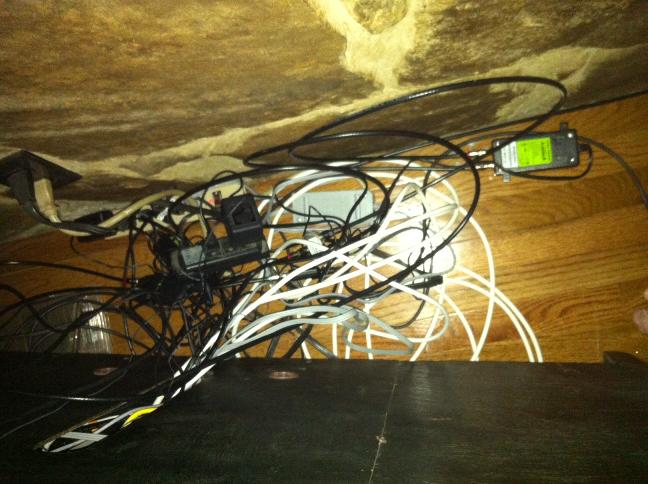
There is a place in your house so sinister, so terrifying, so mind-bendingly awful that dark fates befall anyone who goes there. Few are foolish enough to go there. Those foolish few are seldom seen again. Promise me that you wíll never go there. If you must go there, tells others where you are going, turn on all the lights and tie a rope to your ankles lest you be engulfed and disappear down the throat of madness.

I am speaking, of course, about that massive tangle of cables and wires behind your television. You have one. I have one. Every home in America has one — this writhing den of copper snakes, this mad tangle of serpents sheathed in white, yellow and blue vinyl.

wires

It starts out innocently enough. You plug a TV into the wall. You attach a VHS player, then a DVD player. Next, a game console. Perhaps you have stereo components or surround sound. A BlueRay player and DVR. Your TV is connected to a cable for satellite. Your internet comes through here on a cable to your modem which is, in turn, tethered to your router, which is, ironically enough, the source of your wireless lifestyle.

How easily we forget the many miles of wire supporting our wireless lifestyles. I was reminded this weekend when replacing my modem. I got a new router for Christmas and then bought the modem with Amazon gift credit. The router installed easily in about 10 minutes the weekend prior. Last weekend, I installed the new modem.

Nightmare. I hooked up the modem, called the ISP with the new modem MAC address and then watched the lights on my modem steadily disappear. The next six hours were a progression of disconnecting modem, connecting router, reconnecting modem. Waiting for lights to turn amber, blink amber, then turn green, blink green then hopefully steady blue. It never worked. I tethered my laptop to the mess and gave the router my IP address, my router MAC address, my modem MAC address and an endless dance of other 8 digit codes. I called the router company twice. They spent 2 hours troubleshooting an insane sequence of plug, unplug, replug, unplug, plug. We never got it fixed. The router is somehow defective and won’t talk to the modem.

I spent six hours of my Sunday entangled by a frightening coil of wires that wanted my life and my sanity. I gave it both.

While working in this frightening mess, I recalled the conversation I had a few weeks earlier with the satellite TV installer. I asked if every house had such an obscene tangle of cords and cables. “I’ve seen much worse,” he told me. I think he was being nice.

Then, I asked the question I really wanted to ask. “Do you have such crazy pile of wire behind your TV? You probably have your wires organized nice and neat. Do you think I should spend the time organizing mine?”

He smiled. “It would take a mad scientist to unravel the wad of wires hiding in my house.”

For a moment, I felt better about myself. Then, I started thinking about the kind of mad scientist who might undertake such a thing. I got really, really scared.

Has anybody out there tamed the beast? Have you bothered organizing the wires behind your TV set? Better yet, anybody actually label those wires so you can easily tell which device they power?

Maybe I don’t want to know. The beast in my house is cleverly hidden where eyes do not go. Stay out of that corner. Do not go back there. Ever.

You have been warned.

I don’t do boredom.

My 5 year old daughter is growing up ridiculously well-entertained. She has shelves of books, puzzles and games. She deftly navigates Netflix and DirectTV menus.  She loves Temple Run, Sims and Angry Birds Star Wars on the iPad. She has become a MarioKart master.

Over the recent Christmas break, we fell into some bad habits. We watched too much TV, played too much MarioKart and washed it all down with iPad. We also read books, made up stories, played outside and did other stuff, but Netflix and MarioKart were central features in our three weeks off together.

She got in trouble yesterday — bedtime defiance issues — and lost her Wii privileges. Loss of Wii is a double-hit because it means no Netflix as well as no MarioKart. Losing Wii access is the surest way to capture my daughter’s attention.

Today, a day spent Wii-free, she complained once of boredom. “I’m bored,” she told me. I don’t think this was strictly true. In fact, I think her boredom was feigned to provoke me. It works.

I hate hearing my daughter say she is bored. I hate hearing adults say they are bored. I don’t really understand what boredom feels like. I don’t do boredom. I do frustration, confusion, laziness, tiredness and exhaustion all the time, but I don’t do boredom.

Boredom  happens when a person is utterly uncomfortable or unfamiliar with their own mind. Boredom happens when the room is quiet and a person runs out of thoughts to fill the silence.

Boredom, as it happens, is also a gift. Boredom forces the mind to pay attention. Boredom is a an empty state. Boredom is often a clever disguise for creative resistance. Boredom is the time our mind takes to assimilate new ideas in the absense of incoming stimuli.

My daughter is only five. Maybe she is bored. Maybe she is not. Impossible to say. I know I cannot tolerate willful boredom. Read a book. Make up a story. Sing a song. The mind is always moving. There is no such thing as actually sitting still.

You Fall Down. You Get Back Up.

This has not been a good writing week for me, which is a shame after my major proclamation last week (Inspiration is a habit). I started back to work after 3 weeks off. Naturally, the days before returning to work were suddenly filled by constellations of ideas and epiphanies. I made a commitment to myself to wake up half an hour earlier (6 rather than 6:30) so I could develop the habit of writing first thing in the morning. That did not happen.

Twice my daughter woke up at 4:30 and wanted me to hangout in her room while she fell back asleep. I crept back to bed at 5:30 feeling dazed and bedraggled. Twice I stayed up later than I intended the night before and ignored my alarm. Once I didn’t even bother.

So there it is. My first week back to work and already my resolve was derailed. I know I am not alone. Creating an intentional habit is a hard thing.

I’m not giving up. I will keep working with it until I have made space to do this thing that I love. That is pretty much the entire recipe for success in life. You fall down. You get back up.

Inspiration is a habit

I used to think that blogging was a self-indulgent, narcissistic pastime for people who couldn’t write Serious Things. Serious writers, I thought, struggled in private to set down their most important thoughts on pages that would be read only when a publisher recognized their native brilliance and invested in getting those thoughts out to an expectant public starved for brilliant ideas. I was wrong.

I didn’t write much while laboring under this belief. Writing was painful — a burdensome chore that must be suffered to encounter those rare moments of flow, where idea, intention and action all align.

This blog is rescuing me from that stultifying belief.

I started blogging seriously in September 2011. Before then, I had posted sporadically to LiveJournal and a few other random places. This blog at present is 109 posts strong. I feel like I am just now getting started. I now have personal goals for my blog. I keep an Evernote folder with ideas for future posts. I have met some dedicated writers and have discovered connections with friends I didn’t recognize before blogging. All to the good.

I write this blog for two reasons:

  1. To develop and sustain a daily writing habit.
  2. To overcome my crippling aversion to sharing what I write.

I read a bit about the craft of writing and have noticed a somewhat obvious correlation. Strong, successful writers write every day. Obvious, perhaps, but it struck me as a bit profound. Most successful writers, when asked to share their secret weapon, say write every day without fail. Write if it is easy. Write if it is hard. Write if it is good, bad or indifferent. Write every day. Constantly move forward. I think of this as “holding my seat”.

Holding your seat is about cultivating a practice of writing when you don’t particularly feel like writing. This is necessary to escape the belief that we must wait until we feel inspired before writing. Inspiration feels good and the best writing is often accompanied by that feeling. I cannot wait for inspiration. Inspiration comes at awkward, inconvenient moments — in the shower, laying in bed, driving my chair, sitting in a meeting. I can’t always capture the words in these moments and, when I have the time and tools to write, I can’t always be showering, lying in bed, driving or sitting in a meeting.

Writing everyday is a way of bottling that feeling of inspiration and using it when you can actually sit with it and visit for a while. This blog gives me a focus for writing every day. I am learning not to depend on inspiration, which is fickle and capricious. I believe inspiration can become a habit. Blogging cultivates the habit of drawing inspiration when I need it and can use it most effectively.

I used to write in private, guarding what I wrote from discovery until polished to perfection. The irony was that I rarely finished anything I wrote. I never stopped polishing. Writing was a secret fetish, a lonely compulsion I practiced in complete isolation. Sometimes I wrote things I thought were pretty good. Sometimes I wrote things I thought were pretty bad. It became hard to tell the difference. I found myself endlessly polishing both the good and the mediocre until it all pretty much looked the same. Blah.

I was crippled by an unwillingness to share. The act of writing is solitary but the results of writing should be shared. This isn’t because most writing deserves reading. Most of what I write probably does not need to be read. Most of what I write is not brilliant. Blogging is my way of surrendering the idea of brilliance as a worthwhile goal. Blogging allows me to shortcut that old, anguished practice of hording my words until they merit attention. It has become a creative lifeline and a source of focus around disparate ideas and inspirations. I am grateful to the people who follow what I write here and post comments. I appreciate every visit, every like.

When people read my writing, it affirms my path. It keeps me focused and protects me from feeling overwhelmed by inadequacy. I don’t share everything I write. I don’t incomplete drafts of stories or poems or notes for longer works. Those things can stay private until they feel ready.

Blogging takes the pressure off. Blogging makes writing feel more natural and relaxed. Blogging reminds me that there are lots of other people doing the same kind of work that I do, feeling the same kind of pressure or inadequacy or stress. Those feelings may be a natural part of the process but I don’t have to be captured by them. I certainly don’t have to be imprisoned by the need to wait for inspiration. Inspiration is a habit and, like all habits, can be cultivated, prepared and grown.