What the Internet is Doing to Our Brains (a mid-book review)

I am halfway through Nicholas Carr’s The Shallows: What the Internet is Doing to Our Brains. Carr is the guy who wrote the excellent Atlantic essay “Is Google Making Us Stupid?” several years ago in which he documented his personal sense that reading online was somehow ruining his familiar mental habits — namely, concentration and focus. “Ruining”, I thought at the time, was an unfairly harsh term. He takes a more nuanced, thoughtful approach to his own experience of reading in the book-length study.

Page 125 of a 224 page book is not the ideal place from which to write a review. That said, I am ready to recommend this book to anyone who wants to understand what is probably happening to us in the age of ubiquitous internet access. Carr’s argument expands on the theme established in his Atlantic essay: the internet is destroying our ability to read deeply and engage with text-based narrative in a linear, hierarchical, rational fashion. Hypertext and multimedia “enhanced” text is changing the experience of reading and rewiring the way our minds are able to read.

The Atlantic essay struck me as alarmist, reactionary even. The Shallows places the new ways of thinking engendered by the internet into the context of other mind-altering technologies that actually changed the way our brains worked: the alphabet, numbers, the map, the clock, the codex. Carr examines how these new technologies of intellect have made entirely new thought processes possible and, thus, altered physical structures in the human mind. These changes play out over the course of millennia but they also play out in the course of a human lifetime. In the case of the internet, these changes may play out in a matter of days or weeks.

There’s a lot of strong scholarship in this book. I will come back for a better review 100 pages from now. For now, I just want to share how impressed I am with Carr’s ability to summarize the history of technological innovation, describe how it works and create a meaningful context that is value-neutral and does not necessarily crown contemporary humans as the apotheosis of what we will become. We are not necessarily destined to remain as we are. We are most likely destined to continue our process of becoming something else. This has happened before. It is going to happen again.

Carr says it better. Here’s a great passage from his chapter on the history of reading aloud vs. reading alone:

Like our forebears during the later years of the Middle Ages, we find ourselves today between two technological worlds. After 550 years, the printing press and its products are being pushed from the center of our intellectual life to its edges. The shift began during the middle years of the twentieth century, when we started devoting more and more of our time and attention to the cheap, copious, and endlessly entertaining products of the first wave of electric and electronic media: radio, cinema, phonograph, television. But those technologies were always limited by their inability to transmit the written word. They could displace but not replace the book. Culture’s mainstream still ran through the printing press.

Now the mainstream is being diverted, quickly and decisively, into a new channel. The electronic revolution is approaching its culmination as the computer — desktop, laptop, handheld — becomes our constant companion and the Internet becomes our medium of choice for storing, processing, and sharing information in all forms, including text. The new world will remain, of course, a literate world, packed with the familiar symbols of the alphabet. We cannot go back to the lost oral world, any more than we can turn the clock back to a time before the clock existed. “Writing and printing and the computer,” writes Walter Ong, “are all ways of technologizing the word”; and once technologized, the word cannot be de-technologized. But the world of the screen, as we’re already coming to understand, is a much different place from the world of the page. A new intellectual ethic is taking hold. The pathways in our brains are once again being rerouted. (77)

This is a very enjoyable, well-researched, well-built study. I just hope there are still people out there able to sit still long enough to enjoy it.
Jonah Lehrer is still okay with me

Jonah Lehrer may or may not be a dirty, low down self-plagiarist. I don’t care. I’m not feeling the kind of outrage that is circling the blogosphere. It is probably unwise to cut and paste choice quotes, even your own, from one online publication to another. It certainly seems a lazy thing to do and hurts the credibility of a brand that depends entirely on credibility  (Lehrer as “idea man”).

I still like Jonah Lehrer. I was reading Imagine: How Creativity Works when all of this blew up. The book is insightful and offers inspiring thoughts on how creativity works and can be made to work better. Here are a few things I carried away:

  • Creators don’t always have to understand the meaning of what they create. Sometimes the work is better when they don’t. See Bob Dylan.
  • The mind only creates new things when it is able to idle and assimilate ideas, thoughts and experiences.
  • We learn best through play.
  • Social networks, particularly weak ties, are essential for generating and executing new ideas.
  • Humans are social. We create more effectively when we interact with other people.
  • Criticism is good. Brainstorming is bad.
  • Our history is punctuated with periods of excess genius. These periods can be studied, understood and, possibly replicated.
  • Shakespeare wasn’t a fluke but he might not happen again.

I plan to read How We Decide soon. I will reserve judgment until I find out if that is the same book with a different cover. If so, no mercy. Until then, Jonah Lehrer is okay with me.

Remembering Ray Bradbury

You don’t have to be a die-hard science fiction fan to mourn the loss of Ray Bradbury. Bradbury wasn’t actually much of a science writer. He wrote about possibility. I started reading Bradbury in high school, much later than most of my friends. I read Fahrenheit 451, Martian Chronicle and Illustrated Man in three quick gulps. I admire Bradbury for his relentless optimism. No matter how bleak the times, his stories all finish with a sense of wonder and an expansive view of man’s destiny to make new things and explore. Bradbury believed that we are destined to get away from Earth and explore new worlds. I think he is right.

Bradbury’s most famous novel is probably Fahrenheit 451, which is often characterized as a dystopian warning against the abuse of government authority through censorship and the destruction of printed books. True enough. Had the novel rested there, it would have been a bit dull. Fahrenheit 451 is prescient in how it depicts a society that is saturated with video entertainments. The characters who inhabit Bradbury’s television-obsessed society are shallow, self-absorbed and incapable of sustained self-exploration. The novel rests somewhere between 1984 and Brave New World in suggesting that an authoritarian regime can get away with whatever it likes so long as the citizens are sufficiently entertained. 1984 suggests that books would need to be destroyed to keep people from caring. Fahrenheit 451 says that books can be destroyed precisely because no one cares.

The programming that occupies the 24/7 television schedule is predominantly soap operas and “Cops-style” reality shows.

Bradbury hated the idea of eBooks yet his own work, I think, argues favorably for eText. In the end, when print books have all but vanished, it becomes the life work of passionate people to preserve the content of the books by memorizing them. These volunteers become Books and travel the country, looking for people to inspire. From my reading, Bradbury suggests that print books are merely vessels for ideas. Print books are wonderfully efficient vessels in they way they transmit ideas from one mind to another across boundaries of geography and time. Still, books are most important in the way they transfer ideas, experience and knowledge from one person to another. Even after the books are all gone, there are still Books. The knowledge is protected and carried forward.

The closing metaphor of people as Books is a beautiful metaphor that touches on why I so enjoy being a librarian. We must not fetishize the object of books to the point that we loose sight of what books do for us. Books are tools. Books move ideas forward. The battle cry of Fahrenheit 451 is not simply to appreciate and protect the books. Bradbury urges us to carry worthy ideas forward by any means necessary.

I, like so many others, am grateful for the gift of Ray Bradbury’s work. Amid all the wonderful comment and reflection on Bradbury’s contributions, I like Andrew Chaikin’s comments on NPR’s Morning Edition the best. Chaikin says:

For anyone who longs to make their dreams take flight, Ray Bradbury had some very clear advice: Jump off the cliff, he said, and build your wings on the way down. He was telling us that every impossible dream that comes true begins with a leap of faith.

Bradbury died on Tuesday. He was 91.

Reading is my refuge.

Reading is a physical act. I think a lot about eBooks and the kind of reading experience they offer. I’ve written a bit about the Kindle and how I love reading with it. For me, the Kindle has a similar, but slightly different, talismanic effect as a print book. Critics of eBooks are quick to claim that eReading destroys the physicality of reading and that eReading is not really reading because the text is discorporeal. They miss a major part of the joy of reading. The book itself is only a part of the physical act of reading. The other, to me, equally important part is location. Where I read a book often informs how I read a book and how I receive it.

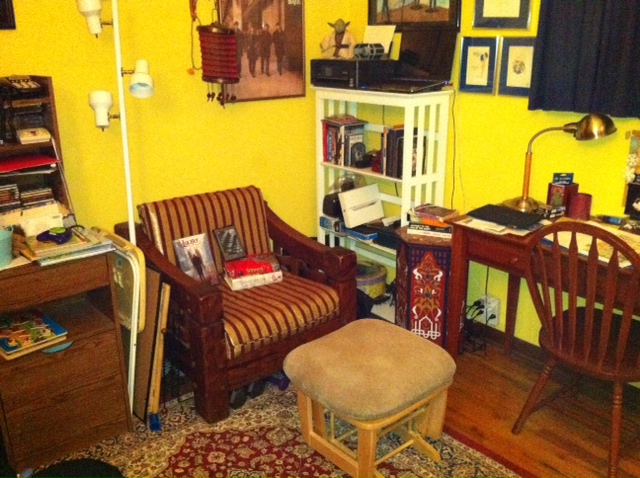
I started thinking of the importance of place for reading after seeing these 17 pictures of gorgeous reading nooks. These spaces are intimate, personal spaces designed to encapsulate a single person in their own thoughts.

Life is tedious, stressful and noisy. I read for escape. Here’s my reading refuge:

my reading nook

My home office is one of my favorite places to read.

Where do you most love to read? I’d love to see pictures of your favorite reading spots.

Reading is fun again. Thanks, Kindle.

Just finished reading George Martin’s Game of Thrones. A truly great read. I enjoyed this book more than anything I have read in recent memory. Someday soon, I may write a fuller review. Not now.

For now, I’m just struck by how much fun it is to read. For the past year or so, I’ve been reading fairly serious stuff and thinking a lot about the mechanics of reading on an eReader. I have extolled the virtues of reading on the iPad and I stand by those comments. But reading on the dedicated Kindle reader is more fulfilling in some ways.

Reading on the iPad has a bit of artificiality to it. The iPad is great for my technical and professional reading. I can cover much more ground and gather news from a variety of sources. But the reading I do on the iPad is primarily for information, for learning, discovering and understanding. My iPad keeps me well-informed.

Somehow in all of this, I had forgotten how healthful it is for me to read for escape, to immerse myself in the details of a time/place that does not exist. I love print books because they are single-function devices. A good fiction book is an escape pod. You get in, pull the cord and go where it takes you. You don’t strictly get to decide where you are going. You are just going somewhere that isn’t here.

But, let’s be honest, print books are sometimes a bit of a drag. You’ve got to carry them around, keep up with them, remember to stick them in your work bag for lunch break, and you never seem to have them handy when you find yourself with an unexpected 15 minutes to read.

The Kindle, like a print book, is a totem. It is a magical object that does that same one thing. Except I can carry it everywhere because I can read on my eReader, my iPad app and my iPhone. Being able to pick up the story when and where I want is a liberating experience. It makes reading fun again.

Having written all this, I’m not sure if this post is about the Kindle making reading fun or simple my own rediscovery that fiction is fun and helpful to my overall well-being.

Either way, I love to read. Reading is fun again. I am grateful, at least in part, to Kindle for helping me rediscover that.

The Kindle is magic (too)

I got a Kindle for Christmas. Not the Kindle Fire. The other one. The one that people get when they actually want to read on it.

For those keeping score, yes, you are correct. I got an iPad last Christmas. There are certainly more important things to honor and celebrate at Christmas than the acquisition of new technologies. This blog isn’t about those things. Still with me? Read on.

For the past year, I have been loving the iPad as an eReader. I have mostly used the BlueFire app and only occasionally the Kindle app. The Blue Fire app is quite versatile and allows easy import of ePub and PDF titles. BlueFire works brilliantly with our library’s eBrary eBook collection allowing the reader to leapfrog over the need to download Adobe Content Server to the personal computer. All that’s needed is a college issued account to access the eBrary database, a personal eBrary account to register your checkouts and an Adobe account to manager the DRM. Headache, right? Much easier than it sounds once you’ve done it a time or two.

My major complaint with Blue Fire is the inability to organize your library. Books all land in one tank and stay that way until you delete them. Also, you can’t easily rename files dropped into your Blue Fire tank. So if the PDF article comes over with a crazy title like ASDAFASDFLKWJERJWERFSADFSDF124244545.PDF, you are pretty much stuck with having to remember what that is. Not cool. Still, I have enjoyed the iPad eReading experience very much.

Reading on the iPad is very easy and enjoyable. I like the size and shape of the “book” in my hand. My major problem has been that I can’t seem to find time to read because every time I pull the tablet out during the day, my daughter wants to grab it from me to play games. Every parent knows, the only time you get to read during the day is when your child is sufficiently distracted doing something else.

Enter Kindle.

Several of my friends have been Kindle readers as long as I’ve been an iPad reader. Setting aside the whole iOS vs. Android thing, most of my Kindle pals say that the iPad is a fine and magical thing but that reading on a tablet isn’t really the same thing as a reading on a dedicated eReading device. General impressions hold that reading on a tablet is more distracting, nerve-racking or just somehow more awkward. I didn’t get it. I thought this was a silly distinction. That reading was reading and it didn’t really matter if it was on a color, touch screen tablet, a gray scale e-ink device or paper.

I was wrong. The iPad still has heavy magic, but the Kindle has a simple, totemic kind of magic that gets closer to what I really love about books. The basic Kindle does one thing and does it really, really well — it gets you reading. There aren’t many whistles or bells. That’s wrong actually. There are millions of whistles and bells. They are just all hidden under the hood. They are built into the framework where you don’t have to see them if you don’t want to. The magic:

  • I register my Kindle to my Amazon account and every eBook I have ever purchased is immediately available.
  • My books follow my progress across every device. I can read on my Kindle, my iPhone and iPad without every losing my place.
  • Not only can I highlight passages and make notes. I can share my notes and quotes through Facebook and Twitter. This is the kind of social reading I keep expecting to find from GoodReads.
  • I haven’t tried the public notes yet, but the idea of crowdsourced text glossing is pretty interesting, yes?
  • The Kindle fits in my jacket pocket.
  • My daughter doesn’t want to grab the Kindle away from me because it is just words on a screen. Nothing special to see here. This device doesn’t play Angry Birds.

I’ve been reading with the Kindle for less than 12 hours now, so there will be more to say on this. For now, I just want to tell my Kindle loving friends: “You were right and I was (a little bit) wrong.”