The wisdom of not doing things, differently

I’m one of those people who enjoys New Year’s Eve. I like the whole self-reflection thing, and I’m a sucker for the idea that Things Are Going to Be Better Next Year. I’m pretty much made for the New Year’s experience. I love making lists and am constantly doing a mental self-inventory of things I might improve about myself.

Several of my friends are posting new years resolutions to Facebook. One has gone so far to post a pretty honest self-critique to Facebook in hopes of spurring personal change.

I think that’s great, but I don’t do New Year’s resolutions anymore. I don’t blame people who do. I just don’t. They don’t work for me. For me, it simply isn’t possible to intentionally create a new habit from force of will and start on January 1 to make it clean start date. I have never had success intentionally adding a new behavior to my catalog of habitual acts and/or modes of thought.

But I came across an idea that needs sharing. The idea is this: You aren’t a bad person. In fact, there’s a great deal about you that is pretty terrific. You have gifts, talents and abilities that people need, admire and respect. You have lots of habits that serve you well and carry you toward excellence.

If you aren’t as excellent as you believe you need to be, it probably isn’t because of something you aren’t doing. It is very possible that you are being hindered by something you are doing. It is much easier to stop doing something old than it is to start doing something brand new. So, instead of making a list of new things you are going to do to improve, make a list of things you intend to stop doing.

This isn’t a resolutions list. This isn’t a list of new behaviors to start. It is a list of old behaviors to stop. Stop doing those things that interfere with your basic excellence. Keep this list with you. Add to it. Consult it often. Ask people who care about you to help you remind yourself when you do something on your stop doing list. You will succeed. You will uncover more of the excellence that is already there.

A few items from my personal Stop Doing list:

  • Stop explaining yourself to others unless they ask for an explanation.
  • Stop being vague when being direct would serve someone better.
  • Stop avoiding unpleasant conversations.
  • Stop assuming that the current situation is the best possible situation.
  • Stop interrupting.

Feel free to tell me how I’m doing with any of these at any time.

Happy New Year.
The future started 15 years ago. It’s time to stop being afraid.

Just had to share this little gem from Tara Barseghian’s MindShift blog post “How Do We Prepare Our Children for What’s Next?”:

We’re 15 years into something so paradigm-changing that we have not yet adjusted our institutions of learning, work, social life, and economic life to account for the massive change. Fifteen years in is when people tend to start thinking about technological change in less fearful and more practical ways. They give up their nostalgia for the “before” and then start to focus on now, on how we can make the tools and resources available to them as productive as possible.

In other words, we are right on time to give up techno-phobia and to tackle the problems and opportunities of the digital world with good sense, pragmatics, realism, and purpose. Once we absorb the realization that we’ve already changed, and that we’re actually doing pretty well despite major realignments in our lives, then we can think about how we want to take this amazing new tool and use it in a way that better serves our lives. Being afraid is never useful. It’s time to survey our lives and figure out what works, what doesn’t, and how we can make real and practical improvements in our schools, our workplace, our every day lives.

This passage recalls me to my original intent in writing Ubiquitous. Quotidian. We are already living in the future for which we have spent so much time waiting. It snuck up on us. I’ll see if I can keep myself away from the Big Thoughts and simply document the simple, unobtrusive ways in which my daily life is shaped, both for the good and bad, by continual, reliable and portable access to the Internet.

The Kindle is magic (too)

I got a Kindle for Christmas. Not the Kindle Fire. The other one. The one that people get when they actually want to read on it.

For those keeping score, yes, you are correct. I got an iPad last Christmas. There are certainly more important things to honor and celebrate at Christmas than the acquisition of new technologies. This blog isn’t about those things. Still with me? Read on.

For the past year, I have been loving the iPad as an eReader. I have mostly used the BlueFire app and only occasionally the Kindle app. The Blue Fire app is quite versatile and allows easy import of ePub and PDF titles. BlueFire works brilliantly with our library’s eBrary eBook collection allowing the reader to leapfrog over the need to download Adobe Content Server to the personal computer. All that’s needed is a college issued account to access the eBrary database, a personal eBrary account to register your checkouts and an Adobe account to manager the DRM. Headache, right? Much easier than it sounds once you’ve done it a time or two.

My major complaint with Blue Fire is the inability to organize your library. Books all land in one tank and stay that way until you delete them. Also, you can’t easily rename files dropped into your Blue Fire tank. So if the PDF article comes over with a crazy title like ASDAFASDFLKWJERJWERFSADFSDF124244545.PDF, you are pretty much stuck with having to remember what that is. Not cool. Still, I have enjoyed the iPad eReading experience very much.

Reading on the iPad is very easy and enjoyable. I like the size and shape of the “book” in my hand. My major problem has been that I can’t seem to find time to read because every time I pull the tablet out during the day, my daughter wants to grab it from me to play games. Every parent knows, the only time you get to read during the day is when your child is sufficiently distracted doing something else.

Enter Kindle.

Several of my friends have been Kindle readers as long as I’ve been an iPad reader. Setting aside the whole iOS vs. Android thing, most of my Kindle pals say that the iPad is a fine and magical thing but that reading on a tablet isn’t really the same thing as a reading on a dedicated eReading device. General impressions hold that reading on a tablet is more distracting, nerve-racking or just somehow more awkward. I didn’t get it. I thought this was a silly distinction. That reading was reading and it didn’t really matter if it was on a color, touch screen tablet, a gray scale e-ink device or paper.

I was wrong. The iPad still has heavy magic, but the Kindle has a simple, totemic kind of magic that gets closer to what I really love about books. The basic Kindle does one thing and does it really, really well — it gets you reading. There aren’t many whistles or bells. That’s wrong actually. There are millions of whistles and bells. They are just all hidden under the hood. They are built into the framework where you don’t have to see them if you don’t want to. The magic:

  • I register my Kindle to my Amazon account and every eBook I have ever purchased is immediately available.
  • My books follow my progress across every device. I can read on my Kindle, my iPhone and iPad without every losing my place.
  • Not only can I highlight passages and make notes. I can share my notes and quotes through Facebook and Twitter. This is the kind of social reading I keep expecting to find from GoodReads.
  • I haven’t tried the public notes yet, but the idea of crowdsourced text glossing is pretty interesting, yes?
  • The Kindle fits in my jacket pocket.
  • My daughter doesn’t want to grab the Kindle away from me because it is just words on a screen. Nothing special to see here. This device doesn’t play Angry Birds.

I’ve been reading with the Kindle for less than 12 hours now, so there will be more to say on this. For now, I just want to tell my Kindle loving friends: “You were right and I was (a little bit) wrong.”

Sir Ken Robinson on creativity in higher ed

Years from now, I expect to look back on my career as a teacher librarian and remember the morning I heard Sir Ken Robinson at the SACS annual meeting talk about creativity in higher Ed. I expect to remember the morning as one of the moments when I understood very clearly that we can teach more effectively and efficiently by focusing our energies toward helping students create their own connections with their own learning. This will also be the morning I finally lost my patience for administrators and politicians who work against a culture of creative teaching and learning. There is too much at stake. We are running out of time.

I’m on the move for now. More on this later.

For now, two offerings:

My rough notes from Sir Ken’s presentation are here.

A quote from H.G. Wells:

Civilization is a race between education and catastrophe

Are eBooks for kids?

Are eBooks good for kids who are learning how to read? Said another way, are eBooks as good as print books for kids who are learning how to read?

This NY Times article has some thoughts from eReading parents on the matter. I sense a bit of ambivalence about eText in their answers. There is a sense that eBooks are great for established readers but may somehow diminish the reading experience for younger kids.

My daughter is four and a half. She is starting to read. I kind of expected this to happen sooner rather than later. Of greater surprise to me, she is also starting to exhibit a writing mania. She sits at the table for long stretches of time, sometimes an hour or so, copying words from objects near her on the table.

Today I got a drawing entitled “The Power Dad”. Yesterday’s picture was Yoplait-themed. Saturday’s was “Pink Panther Cartoon Classics”. You get the idea.

As a parent, my job is to worry about stuff I have no control over. My daughter loves books, but occasionally I worry that she isn’t spending as much time with paper books as I did when I was a kid. She reads paper books a lot but also spends a good deal of time playing iPad, watching PBS kids’ shows and playing Wii. This is in addition to hours of unstructured high imagination time. I don’t specifically worry that she isn’t loving books enough. She loves books. She treats books well and handles them as important possessions. The interesting thing is that she reads on the iPad nearly as often as she reads on the page. And the iPad apps are interactive, encouraging letter tracing, word sounds and pattern recognition.

Anecdotally, I’d say her iPad reading has contributed greatly to her early reading success and has fostered a early fondness for constructing words as well. So, no worries about eBooks or other eText experiences somehow ruining her mind. She will learn to read soon and well because her home life is supportive of reading.

And that gets me to my more specific concern. I have read studies (need to cite here…) which indicate that the greatest predictor of future academic ability is the presence of books in the home. Does that include invisible eBooks or print only?

My guess is that a home where print books are ubiquitous is more likely to be a home where reading is commonplace. Reading is in the water and gets into the DNA at an early age. This probably comes from seeing parents read. I remember growing up and watching my dad read books. I remember enjoying reading my own books while he was reading his. So here’s the thing: if most of my reading is done on the iPad or other eReading device, how can my daughter differentiate the times I am reading a novel  from the times I am reading the “news” (for me, RSS feeds) from the times I am playing Word Dash, Traffic Rush or some other frivolous thing?

Reading is a personal thing, but the image of someone reading is very public. That changes with eReaders. Wonder what the impact will be and how much that will matter?


Amazon’s eBook lending library is not the library apocalypse

A few days ago, Amazon announced its free eBook lending service to Amazon Prime members. I read this program summary from AppAdvice and thought, “Uh oh. Here it is. The library apocalypse.”

I didn’t rush to blog about this, which actually worked out in my favor. Cooler heads prevail. Bobbi Newman of Librarian By Day has this very succinct, reasonable assessment.

In short, there isn’t enough content freely available at Amazon’s lending library to compete with the sheer volume of free content available in public libraries. The one free eBook per month (with restrictions) cannot compete with the free access to multiple books (ie. “all you can read”) available through public libraries.

Also noteworthy: this service only works for actual Kindle users. This service is intentionally built not to work with iOS Kindle apps. This is mostly about an incentive to give people one more reason to buy a very moderately priced Kindle eReader or the new Kindle Fire. Great PR move.

Amazon Prime is a good deal and this free lending service looks pretty interesting. I see a few titles in the list that I want to read myself. A bit tempting to try. Amazon is trying to lure heavy readers into buying their eBooks from Amazon. That’s fine, but most serious readers I know use both the public library and Amazon.

What do you think? Can Amazon lure you away from your local public library for the price of one free borrowed eBook every month? Or, might the reading tent be big enough to accommodate more than one option for getting free stuff to read when you want to read it?

How my iPhone helped a blind student

Here’s one of those small daily miracles that comes from having ubiquitous internet access in your pocket and ready for action.

A blind student came into the library today. He asked for someone patient to help him scan his chemistry lecture notes into Word using OCR so the text to speech reader could parse his instructor’s notes for him. We talked about this a bit, and I told him I thought we could help.

I quickly discovered that our lab scanner is not currently equipped with OCR capability. You scan a document and can only get JPG, TIFF and PNG files. No good for text to speech readers.

Turns out there isn’t a single public use OCR scanner at the entire college. That’s a problem I intend to fix pretty quick. In the meantime, this student was out of luck and his chemistry notes were inaccessible.

Then I remembered the document scanner app I recently downloaded onto my iPhone (ImagetoText). A 25 page document. I snapped a picture of each page with my phone, let the app translate the image into text and then emailed the file to myself so the txt file could be pasted into Word. Somewhat labor intense but worked pretty well. I was impressed by how well the text rendered. His notes are complete since the chemistry diagrams are non-textual but a pretty great solution in a pinch.

One Thing You Need to Know: Marcus Buckingham

I’m a big fan of Marcus Buckingham. If you don’t know about Marcus Buckingham, you should probably start by watching this:

So much about the way we measure ourselves is based on our personal weaknesses rather than our personal strengths. In school, a student who is really great at writing but not so great at math is usually given more math and less writing. This is done to help remediate the deficiency. Helping students get better at math is a good thing, but the remediation often comes at the expense of time spent practicing areas in which the student is naturally gifted. The student is frustrated because all of the school time is spent doing things he isn’t good at and by the time the remediation drills are done, he is so tired he doesn’t have energy to dig in on the other stuff. The problem here is that the amount of time and energy working on weakness control probably yields small gains. Not very efficient. A person who is naturally bad at drawing is never going to be an artist. Mediocrity is the best outcome that can be expected. The problem is that this mediocrity in an area of weakness detracts from time spent becoming excellent in the only area a person can become excellent — in an area of personal strength.

Job evaluations are most often designed and delivered to help call attention to areas where the employee can pick up the slack. I can think of many job evaluations where I walked in expecting to talk about the things I wasn’t doing and the areas in which I needed to contribute more. The problem here is that I am naturally limited in some areas, like organization. If I am told to focus more time becoming highly organized, then I am also, in effect, being told to spend less of my time developing and sharing new ideas (a personal strength).

Time and energy are limited. Poor performances need to be addressed, but time and energy are most usefully invested in developing on existing strengths.

That’s the core concept of One Thing You Need to Know. Marcus tries to provide one central organizing insight for successful managing, leading and personal success.

Great managers discover what is unique about each member of their team and capitalize on it.

Great leaders articulate a clear, common understanding of what the team’s better future will look like. Being clear about the future is way more important than being correct.

Successful individuals discover what they don’t like doing and figure out how to stop doing it.

This probably sounds rather trite, but the discussion of each of these elements is quite profound in its simplicity.

My biggest takeway: as we grow older, we become more of what we already are. A strong, satisfying career is built on a person’s ability to focus almost exclusively on developing excellence in areas where natural strengths already exist. Successful careers are also built on a perpetual, allergic avoidance of doing things that do not express one’s strengths. Don’t throw your time and energy into developing your weaknesses toward mediocrity. Partner with people who can do things you can’t. Be passionate. Be relentless. Be honest with yourself. If you don’t love what you are doing, you should probably be doing something different.

This is the kind of controlling insight I want my work team to have. This is the kind of experience I want every student I work with to develop. This is the kind of confidence I want my daughter to carry with her into the world.

Every one of us is limitlessly strong so long as we don’t dwell unnecessarily in our areas of weakness.


I like choices.

I’ve been hearing quite a bit lately about the paralyzing effects of having too many choices. I hear it most frequently in the context of students choosing majors, but it also applies on a lesser scale, perhaps, to the grocery store cereal aisle, long distance carriers (do people still do that?), and cable TV channels (again, do people still do that?).

The idea is that the human brain cannot adequately process the complexities created by a surfeit of choices. That’s why in our very diverse society we tend to keep things simple: Republican/Democrat; Coke/Pepsi; Boxers/Briefs. The reality is usually much more interesting and complex. But interesting and complex don’t really sell very well, so… keep things simple.

I like choices. I like complexity. It may be my buddha-nature shining through. My allergy to artificial choice reduction. Buddhists call it non-duality.

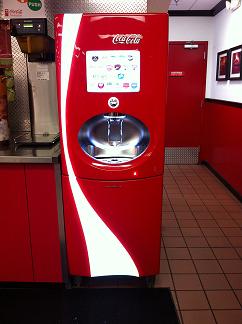
I most recently embraced my love for choices while eating dinner at Firehouse Subs. Last Saturday, I had dinner at Firehouse. They’ve got a brand new, shiny soda fountain that features a touch screen with your basic drink options and then a sub-menu to put a different flavor twist on each of these main options. First you select Coke and then you decide if you want regular Coke, cherry Coke, orange Coke, vanilla Coke, etc, etc.

I flipped out. This is, of course, the 21st century soda fountain. The soda fountain was an institution my generation pretty much entirely missed out on. Sonic tries to give you the same experience but it isn’t really the same.

What a lovely machine to offer so many ridiculous options and subtle variations. You could visit something like 120 times and never experience the same drink twice. Fascinating.

Of course, my wife thinks I just like to touch buttons on screens. She may be right. It was almost an iOS soft drink experience.

In case you are wondering, I started with vanilla, cherry Coke and then refilled with raspberry Coke. Both terrific. Only 118 more flavors to go.

I like choices. Let’s keep choices, please.

21st century soda fountain

7,000,000,000

Sometime yesterday, a mother gave birth to the 7 billionth person on the planet. At least, that’s the news story. There’s a bit of uncertainty involved. Turns out predicting population growth isn’t an exact science. The math nerds at the UN and the US Census Bureau differ a bit on the precise numbers. This doesn’t have to be exact. This is a lot of people.

The pure number itself (7 billion) is hard to get my head around. Sure sounds like a lot of people, but then the infographic nerds at Per Square Mile show us that the entire population of the world could pretty easily crowd into Texas with a population density of New York City or we could stretch out a bit with a population density equal to Houston and still not fill up the entire United States. Okay, that makes me fill a little better. So, 7 billion people won’t physically fill up the earth. Obviously not, since most of these 7 billion people are living in Asia and Africa.

What’s more fascinating is the rate at which the population increases. We hit our first billion in 1804. The second billion took another 123 years. The third billion just another 33 years with shorter intervals each billion since. I remember hitting 6 billion in 1999. 7 billion came quick.

How did this happen? This very clever video explains it pretty well.

I remember learning in high school about Malthus’ idea that the industrialized society’s geometric population growth could not be sustained by the arithmetic growth in the food supply. So far, this hasn’t proven out. We may not be far away from testing the theory.

The smart people at Per Square Mile are right in saying that the major issue isn’t really how many people are currently on the planet but how many of those people want to live like Americans. If everybody wants to live like Americans, then we’ve got a major head scratcher on our hands.

The symoblic power of numbers is really to give language to things outside the scope of everyday experience. For the UN, this was an opportunity to call for action.

Fascinating times.