Why SEO Matters to Librarians

I spent last Friday at the Knoxville-based Social Slam, an annual one day conference about social media as a tool for business marketing and communication. As usual, I found myself powerfully inspired by ideas from a bunch of folks in professions outside my own. This is how professional development is supposed to happen. Toss yourself headfirst into a gathering of smart people with adjacent but different interests from your own and start talking.

As an educator and librarian, I found a lot to learn from small business owners, marketing reps and social media mavens. I will post some of those lessons along the way.

I arrived late, missing the morning keynote. My first session was a primer on search engine optimization, or SEO. SEO is a series of skills, design practices and habits intended to improve a website’s ability to be found.  Information is not scarce. Attention is scarce. Getting found is as important as having something unique and useful to offer. If you can’t get yourself, your business or your cause found online, you might not exist. There are several essential habits to make your online presence more findable. The panel talked about the importance of clear, accurate metadata. They discussed the usefulness of well-crafted headlines and tagged images. All of these SEO-related suggestions are habits of good web design. They shouldn’t surprise anyone, least of all librarians. They make websites, including library websites, findable.

Librarians care about SEO because we need our sites to findable. Students Google my library pages more often than they click to them from college pages.  I have seen members of my own team Google to our page rather than use browser bookmarks. Google (okay, and maybe Bing) are the gateway to getting found and being used.

Nothing shocking. That did not catch me off guard. Librarians should care about SEO because we need to market ourselves and be found.

Then the conversation turned to the social graph and the work Google and others are doing to personalize search results based on shares, clicks and other social metrics. Wonder why Google Plus exists? Google needed to get access to lots of social information about web user behavior and most of the best data was locked up in Facebook. Google Plus exists to shape what users find when they search. Google wants to learn enough about your interests and patterns of web use to predict which 2 or 3 sites will be most useful from a search results page of 23,000,000. They give you thousands of pages of results but really only care about the first few on that first page. They want those to be right, accurate and contextually relevant. They are getting better at it.

Search is getting personalized. As social interactions are folded into search algorithms, the social media footprints of a business or individual becomes more important. The panelists demonstrated how tools like Google Author can lift a blogger up search results and how Google Business listings can create a strong initial landing page in Google results. Well-focused content on Google Plus, Twitter and other sites can tie users to your site and create a kind of gravity toward your pages. Better yet, their check-ins and mentions can create a kind of gravity to bend their friends and their friends’ friends search results toward your site. This is important to librarians for a few reasons.

Librarians must understand and help others to understand how search works. It isn’t only about keywords anymore. Things are more complex.

Librarians need to know how content providers can shape their rankings to become more visible in a targeted market.

Most interestingly, SEO in the age of social search means that search results are personalized. Two people logged into their Google accounts can search for the same topic at the same time and get very different results. The age of one-size fits all library instruction is going away. Search is personalized; the results are custom-tailored.

We are just at the beginning of this new kind of search. I wonder what it will mean for phone-based reference consultations. “Go to Google, type this, visit the third link down” type information won’t work anymore.

We have to let people know how this kind of searching works. We need to advise them on the benefits, which are many, and help them opt out if they wish to do so.

I did a quick search on librarians and SEO and didn’t come up with much. Most people, like me, have been coming to the topic from the perspective of marketing their sites. SEO is how we get found.

I left the session realizing that my profession keeps getting more and more interesting. SEO is about how search works. If we can’t master that concept, we can’t be effective.
Meeting Our Biological Selves

There are two kinds of experience that deliver immediate, intimate understanding of the rude facts of our biological selves: sex and the gastrointestinal virus. Warning: this post is not going to be about sex.

I have been carrying a stomach virus for four days. Today is the first day I feel reasonably good. When asked how I am doing, I sometimes say that I feel “almost human”. This is wrong. The feeling human part happens when you are alone in the bathroom at 3am and your body responds to needs completely independent of thought or ideation. The feeling human part happens when you are shivering underneath three blankets, feeling your joints shudder and shake with fever. The feeling human part happens when your guts speak in urgent susurrations, a wordless language that says everything it needs.

Not to be gross or vile. There is a kind of epiphany possible here. Especially if you are using the time that you are awake to reacquaint yourself with Ralph Waldo Emerson and the fine turns of thought possible from the mind well-refined. We elevate our minds. We prefer to think of ourselves as energetic beings of thought, insight and inspiration. We believe our minds carry us closer to the truth about God and divine purpose and original intent. And yet, in the same moment, our minds are tethered to our gross, rude, vulgar selves, the biological parts that are dirty, reflexive and tortured with appetites.

Most spiritual writing I have read posits these two realities in opposition. We are told that our spiritual selves are trapped in the animal prison of our flesh. And then, the Work becomes separating our spiritual selves from our biological selves. We spend our lives struggling against what we are in expectation that one day we will be made into something else.

Better perhaps to work with the dichotomy as it exists. There is much beauty in the knowledge that we are both. Not that the body is a flawed vessel that carries the perfect spirit, but that the body’s rude limits inform the spirit and teach struggle so that growth is possible.

If God created us, how perfect his design. To place pure idea, insight and reason into a sensing, experiential and irrational form. We are better for being in our biological bodies. Our biological selves prove that we belong to this life, to this world and to the universe itself.

Here is meditation to work with: Wretch. Be thankful. Wretch again. Understand. Amen.

Marginalia

A colleague I respect very much died a few weeks ago. He taught history. We were friendly but never close. We rarely found ourselves in the same place at the same time. I never made an effort to correct that. I should have.

He loved books and the way books carry ideas from one person to another across time, across space. He loved books as physical things and wrote in the margins of the books he was digesting.

Before he died, he left a few books from his collection to my library. I am reading one of his those books now because I want to enjoy something that he enjoyed and want to benefit from the notes he left behind.

I am reading Emerson: The Mind on Fire by Robert D. Richardson, Jr.

Ralph Waldo Emerson is a personal favorite of mine, though I sometime find it difficult to explain why. My daughter, Emersey, takes her name from Emerson. Emerson was the subject of the first lecture I ever gave. I was a senior in high school.

Emerson is difficult. I struggle with him a lot. Sometimes he writes in oversimplistic aphorisms. At other times, he relishes long, overly florid abstractions that do not connect to reality. He is optimistic but often lapses into outright manic idealism. His philosophical work with Plato, Kant and Hume is beyond my grasp. His religious ideals are just plain silly.

And yet, I am drawn to Emerson. I keep pressing my mind against his prose, believing there is something profoundly rewarding at work in there. Emerson celebrates direct experience. He requires scholarship to have a purpose. He sees poetry and art as a vehicle of transcendence. He understands that religious salvation is about the here and now, rather than the hereafter.

We are kindred spirits, though we do not yet understand one another very well. I keep working with him, and he, I believe, with me.

We are both prone to extremes. We both struggle with ideas as a necessary precondition for experience. We both find refuge in nature but believe our times are moving toward an extraordinary manifestation of greatness. We are patriots in that we believe the genius of our country is in finding and feeding the spirit of creativity and innovation. Emerson wrote during the ascendancy of this genius. I am uncertain if I am writing closer toward it apex or if that spirit has crested and now makes it slow descent.

Emerson wrestled with the ancients — Plato, Jesus, Socrates.

Emerson speaks to the 21st century. I am not yet sure what he is saying.

All of this sits in my mind as I read through the pages that my now gone colleague also read. I see the lines that he underscored and the words scribbled in the margins. He read this book mostly as an attempt to tie earlier influences to Emerson’s later works. He notes passages from journals that correspond to later essays. His notes are not profound. They are thin and few. They stop 105 pages in.

I want to ask why he stopped making notes there. Did he not finish beyond that point? Did he stop making the connections solid with notation? Later this evening, I will have read past the point where he stopped keeping notes. I will keep going, enjoying this one last connection we share to a thinker we both admire. It is enjoyable to hold this book he held and consider the value of things he thought worth noting. I will keep going and I will want to ask him, why this note? Why not this?

I will want to ask him why he thinks Emerson matters and what we should be taking from him that can be a benefit to everyone else.

But I can’t ask these questions. It is one way conversation. I have his book, scratched partway through with marginalia. It is insubstantial, not enough. I am on my own to explore this life that matters, for some reason, to both of us. I wish I could explain better why I feel such a responsibility to work with Emerson and why it is a comfort to know that, at least for a little while, I had a companion traveling the same road.

Writing is Dangerous

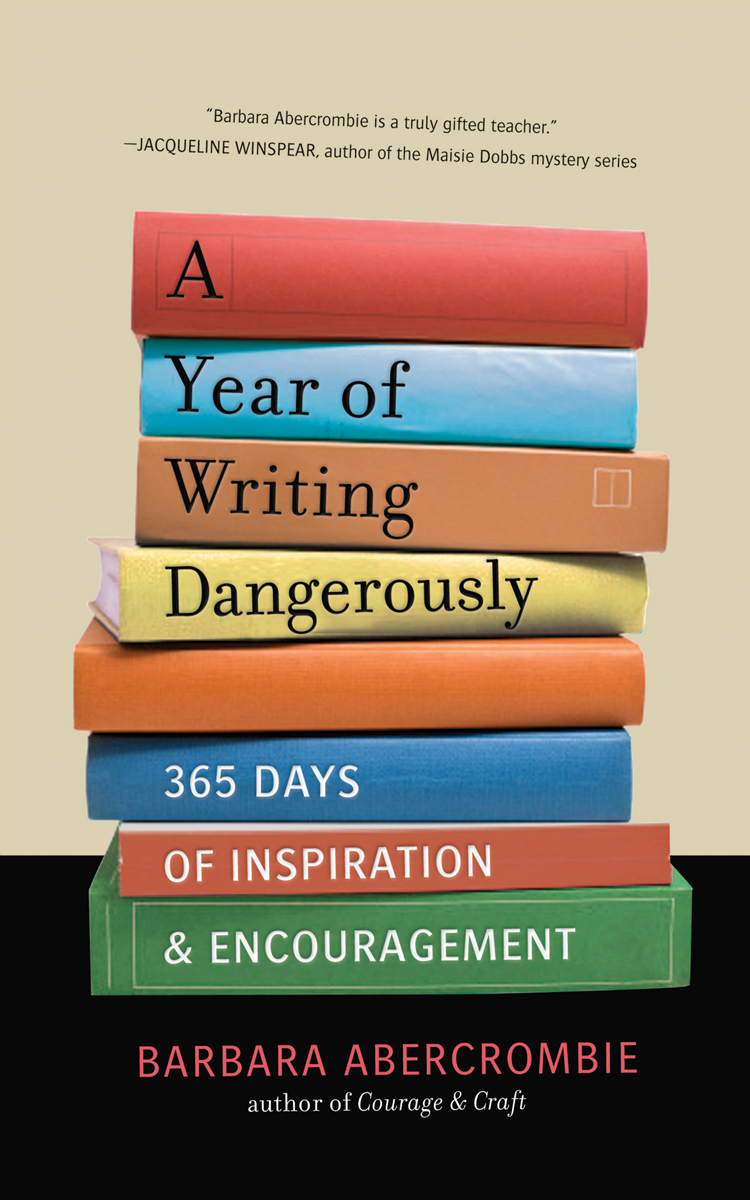
A few days ago I recommended Barbara Abercrombie’s Year of Writing Dangerously as a source of inspiration for aspiring and/or struggle writers. Just realized I never got to the “writing is dangerous” part.

Writing can be exhilarating, challenging, and terrifying but dangerous? Yes.

Writing is dangerous work because it always requires us to work with the pleasantness and unpleasantness of our lives. When we write memoir, we are writing about our lives. When we write non-fiction, we are writing about our lives. When we write fiction, we are writing about our lives.

Writing is dangerous work because it is done in isolation. Writing always requires a kind of seclusion. Willful seclusion makes us weird. This is not normal behavior.

Writing is dangerous because we borrow stories from the lives of people who love and trust us. Family and friends be warned. Story always comes first. Your names may be changed but your stories belong to us.

Writing is dangerous because it makes us neurotic and insecure. Okay, technically we start out neurotic and the writing just makes those insecurities manifest. Different paths, same result.

Writing is dangerous because it requires time and concentration. There is no shortcut. You cannot skip through or cheat. You have to spend the time in the seat or you are not writing. There is no escape.

Writing is dangerous because it introduces us to ourselves. We think we know who we are, what we believe. Then we write and realize we are liars and hypocrites.

Actually, looking back, I’m not sure how much of this is Abercrombie and how much is my projection onto Abercrombie. Your results may vary.

What do you think? Is writing dangerous? If so, how?


While the Iron’s Hot

I’m not in a position to teach anyone how to be a successful writer, but I can share an experience that corroborates advice I have often been given but somehow never managed to accept.

A few weeks ago, I had a great idea for a story. I started to work right away. I couldn’t not work on it. I had to do the work. It didn’t matter if the story was coming out left, right or upside down. I just needed to get the words that were inside moved to the outside. Things were going well. Words were piling up, and the story was moving forward.

Then I got sick. Then work got busy. Then I got frustrated. I lost the story.

The story is still there. I still intend to write it, but the urgency is gone. It bled out in those few quiet days when I was not writing. The story was happening. It was real. It was urgent. And then it was gone.

When you start a piece of writing, start it quick. Don’t think too much. Don’t ponder or plot too long. Don’t hit the snooze bar in the morning, and, for God’s sake, don’t stop.


Year of Writing Dangerously by Barbara Abercrombie (book review)

This blog was never supposed to be about writing. Still, I  have been thinking and writing a lot about writing lately. This blog has put me in touch with a community of people are also thinking and writing a lot about writing. We are always seeking inspiration, communion and support. To those friends, I recommend Barbara Abercrombie’s Year of Writing Dangerously: 365 Days of Inspiration & Encouragement

As the title suggests, it is basically intended as a year-long writer’s toolkit for inspiration. I read it in 3 days. The entries are short — one or two pages for each day. Abercrombie provides practical, encouraging advice for writers. She does not pander or become too precious. She appreciates that writing is a struggle but doesn’t get wrapped up in the romance of that struggle.

She offers great quotes and stories from effective writers from across time. She blends their advice into a few basic tennets:

  • People who want to write better or write professionally must write every day.
  • Writers must read a lot.
  • Writers need a support network of disinterested peers who can criticize in a positive, ruthless manner.
  • Family members should not read what we write until the work is published and it is too late to turn back or make changes.
  • The best writing results from taking bad stuff out more than from adding good stuff in.
  • Unfortunately, it is as difficult to write a really bad book as it is is to write a really good book.
  • Always finish. Unless you can’t. Then don’t finish.
  • Find your process and stick with it. What works for others may not work for you. There is no recipe.

abercrombie-final.inddThe appendix offers the gift of 52 writing prompts to unstick stuck writers. They are pretty good.

Just a few pages into the book made me feel like writing. If you write or spend lots of time thinking about writing, you will enjoy this book very much.

Familiar Faces, Unmet Friends

Twenty years ago, I had a dream that has stayed remained with me. I don’t often remember my dreams. When I do, they feel important so I pay attention.

In this dream, I am wandering the halls in a big, empty house with no furniture. I come to an open door and enter a large room. The room is crowded with people and creatures. Many are mundane. Some are fantastic. I have never met these people, these creatures, but they recognize me, and they are glad I am there. They smile and make me feel welcome.

I woke from that dream feeling like this was a roomful of not yet imagined characters, relieved to be finally discovered. They were glad and patient. No one spoke. They just smiled and nodded, as if they had all the time in the world.

I was thinking about this dream after writing this morning. I was working on a piece of improvised fiction from a prompt. The writing itself didn’t go especially well but I was struck by how much fun it is to write sometimes and find entire people living inside you with their own thoughts, feelings and ideas about things that seem quite separate from you. It is a powerful feeling to discover these other lives inside of you, unseen and unobtrusive, waiting for their turn to be discovered through words. Just like that roomful of unmet friends from twenty years ago.

This is a very powerful feeling that arrived like a gift. This is a happy reminder of why I ever bother writing at all.

Writing at 6AM

I woke up early this morning to start writing. It is still dark outside. The birds are just now starting to sing. I have no idea what I’m doing or why I am doing it. I had the thought that writing might be easier first thing in the morning, and that I might sneak my way back into the story by jumping into it fresh from last night’s dreams. A bit like ledge jumping from one roof to another. I didn’t make the leap.

194 words. None of them particularly interesting or useful.

I am not complaining. I only want to document that this moment happened. I woke up at 6am. I got dressed. I started writing. I was here. I understand that this is how this works.

More Than Content

I have been thinking about Jim Rettew’s comments about the Idea Industry and how treating ideas and inspiration as commodities limits how we can interact with and use those ideas.

The Idea Industry is way bigger than TED. It includes writers like Jonah Lehrer and Malcolm Gladstone, podcasts and, yes, bloggers.

As one of those bloggers, I sometimes wonder what it is I am actually doing when I write for other people to read. Am I just moving ideas around from place to place, pointing to interesting sites that others might find inspiring or, at least, amusing for a short while? Or does my work as a blogger contribute something greater?

We often talk about blogs and books and articles and movies as content, as if it were something physical that resides inside something else. A specific, discrete something with its own properties than can be placed in a vessel, carried somewhere else and then transferred to another vessel. That is the connotation of content. In this model, art is about information transfer.

Blogs and books and articles and movies can be more than just content. Content is information. If blogging is just about information transfer then it is easily done and pretty much anyone can do it.

My best blog posts, the one’s that get comments and get people interested, are the posts that tell stories. Good blog posts share something from personal experience and connect it to the experience of other people. That is what we can do here to add value. We can tell stories. We can tell stories about ourselves, people we know and people we invent. We can tell stories as a way to connect insights to experience.

Come to think of it, this is what great teachers do, too. They move beyond lecture and tell interesting stories to help students make their own insights.

Come to think of it, this is what Jesus and Buddha did. They didn’t lecture or preach a lot. They pretty much went around telling people interesting stories that connected ideas to experience. That’s how major movements get born.

The way we think about what we do determines the value of what we do. If we trap ourselves into the act of creating content, that is all we will ever have to offer. We can offer more of ourselves and help make the best ideas come to life.

We can tell stories.

TED Talks as One Night Stand

Last week, I wrote a bit about the limits and virtues of TED Talks as a vehicle for ideas that can transform how we work and live. I love TED Talks and usually find them wildly inspiring. The trick is what to do with that feeling. Where can we carry that sense of inspiration? How do we apply it?

Jim Rettew offers great insights on the nature of TED and what we should be doing with it. You should read “Are TED Talks a One Night Stand With Ideas?”

Rettew offers two essential insights for me. The Biggest Ideas are usually statements of problem rather than statements of solution. He offers Picasso’s Guernica as an example.  To be fair, Guernica is a different sort of thing than a talk, but the example gets Rettew to this statement:

Great Ideas, then, don’t merely easily please us with their immediate utility — often, they break our hearts with desperate futility; with both the aching impossibility and sure inevitability of the trials and tests of human life. But that’s precisely what makes them Great.

Which leads to Rettew’s other essential point about the TED Talks way of sharing: “It gives us the climax of epiphany, without the challenge and tension of thought.”

The habit of thinking represented by TED Talks delivers the quick thrill of insight without the underlying work of thought, reflection and bewilderment.

Rettew sees trouble not specifically with TED Talks, but rather the Ideas Industry. TED Talks are just a useful exemplar.

TED Talks are powerful, useful and generally helpful. The trouble is with the easy trust that TED Talks can create. The TED Talks website is an epiphany machine. Since viewers receive these epiphanies without the preliminary discomforts of confusion, critical thought and experience, the machine delivers the appearance of solutions as a form of entertainment. We can feel better about things because smart people have come up with great ideas. Action is not required. We aren’t asked to actually do anything.

Great Ideas, Rettew tells us, require something from us. Great Ideas require action. We are more than pundits and consumers.

As bloggers, we are part of the Ideas Industry. When I post, what is it I am doing? Am I contributing something useful that can be used to make something useful happen? Am I just a conduit for the comfort of other people’s epiphanies?

Maybe the idea of epiphany is what I am actually working with in this series of posts. The assumed belief that useful insights and solutions always arrive as epiphanies, and that progress always happens in unexpected, brilliant leaps forward.

We need those leaps sometimes, to be sure.

More often, progress comes from slow, steady application of reason, hypothesis and process of elimination.

The Idea Industry tells us that epiphanies are required to make things better. The problem is that epiphanies are not something we can count on everyone to provide. If we are going to improve things that matter, we need to get everybody into the game. We need to encourage both kinds of thinking.