Writing, Running, Meditation and the Inescapability of Time

Being on vacation this week with no specific plans or agenda has given me the chance to reconnect with three activities that always help rebuild my sanity and restore my soul: running, writing and meditation. All three are habitual acts which, when practice, help me crawl out of my head and back into my body. While running this afternoon I was struck by the common thread between them. The practice of each puts me into a direct, inescapable experience of time.

When running, there are no short cuts. You set a goal (either time or distance), you start running and, whether you reach the goal or shop short, the entire time you are running there is nothing else happening. There are no distractions. There is no escape from the fact of what you are doing. When you are running, your body is doing only that. Your mind may be thinking thoughts. You may not be thinking about running but some part of your mind is always aware that you are running. There is an autonomy that takes over the body when you are running. Running does not require careful thought or specific planning beyond the simple, consistent mantra to keep going. The thing I like about running is that direct contact with time. Twenty minutes is not an abstract thing. When running, you feel every part of twenty minutes. There is a focus that comes from no where else. When running, you are doing those twenty minutes and those twenty minutes are doing you.

Writing is the same way. The only way to get words on a screen is to put them there. You cannot simply wait for them to appear. You have to put them there. There is always a first word. Then a second. Then a third. Usually, the words quickly group themselves into sentences. When you are writing well, you aren’t concious of reaching for specific words. You build the page by sentences – one after one, like laying bricks side by side on a wall. In writing, there is no escape. You can”t cheat. You have to hold the seat and do the time and stack the sentences together until they make something that did not exist before. Again, like running, writing requires its own focus. You cannot write while thinking of anything else. You can’t write and do the dishes. You can’t write and pay the bills. When you are writing there is an order and a logic to your life. You are writing and you are only writing and when you are finished writing you are doing something else.

Running puts me into the mindset for writing. When running, I always get the next idea or the next sentence or some other clear, specific gift to help the words get on the screen.

Mediation is much harder. If you really want to be placed in direct experience of time, you should sit on a cushion and do nothing but sit. You realize quickly that the mind is a wild creature, an untamed monkey, constantly trying to escape the present moment and rush forward to some unseen moment that does not yet exist. It is a painful thing. It is unpleasant and frightening. It feels maddening and you are always a bit relieved when it is over. And yet, when you  practice meditation and cultivate the habit of sitting with no gaining idea, you find you are able to settle down into the moment. In those few seconds, your body and mind are the same. They share the same purpose. They are relaxed and calm. They belong with you, and you belong with them. This is called mindfullness.

And then moment is gone and your mind is rushing ahead again, careening away from your seat with manic speed and abandon. Why is your mind so desperate to escape? What is it that has your mind so frightened? And even as your mind rushes away and you feel the loss of those few perfect moments, you recognize the distinction between how it felt when you were sitting and mindful and when you are were sitting and grasping, desperate for the ending bell to ring. And that recognition, while tinged with frustration and loss, is also a realization that we are delusional most of our waking lives. That we live and breathe and move inside of time but constantly struggle to place ourselves outside of time. We are always wasting these few fragile moments that belong with us to reach for things that do not yet exist. We are psychotic and time-sick and vow never to sit in meditation again because the experience is so disturbing and unsettling. But then we stand and are grateful because we have once again learned to see how moments connect – how the present becomes the past and also becomes the future. And how neither the past nor future have ever really existed. Only the present. Only this place. Only the place where I am now and the place where you are and so on.

I am writing about three kinds of transcendence. Often difficult. Often uncomfortable, yet somehow, each brings me back into myself. I have a tendency to climb up into my head and stay there like a cat caught in a tree. It is good to know I can always find my way down if I am willing to be uncomfortable and feel the passing of time. The experience of discomfort is always worth it. It always places me safely back on solid ground.
How Twitter Connects Writers with Readers

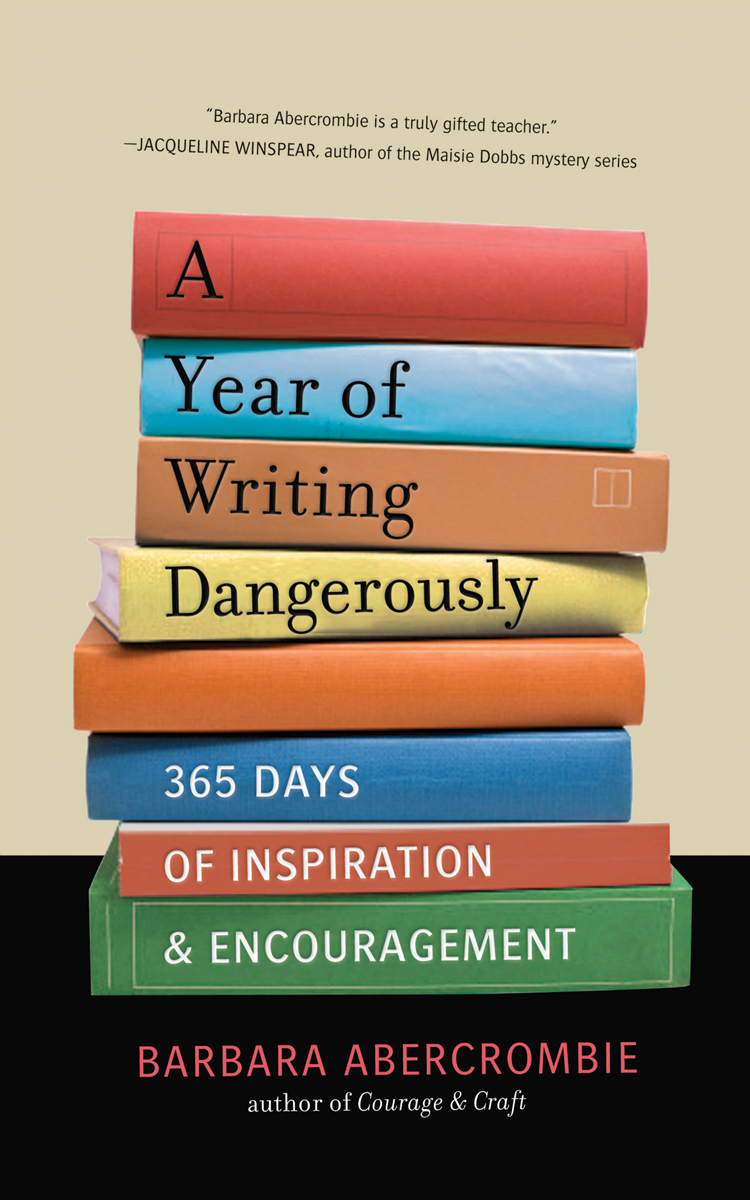
Two months ago, I posted a review of Barbara Abercrombie’s Year of Writing Dangerously. It is the kind of thing readers do spontaneously when they enjoy a book. They want to share that book. Readers who blog share by writing reviews.

Yesterday, the author of that book, Barbara Abercrombie, tweeted a link to my review. It was kind of her because it gave my review new readers. It felt really good to have an author I enjoyed read and acknowledge my own work in some small way. It was a nice gesture.

Here’s the thing: her random share was helpful to both of us. I have felt stuck for weeks and got myself unstuck last night because I recalled the things that originally inspired me in her book, I felt a small sense of acknowledgment from someone further along the writing path and I reread my post with fresh eyes and liked what I saw. I wrote again last night, and it was fun.

The share was helpful to her because it connected her readers with a favorable, honest reader review of her work. Reviews in vetted publications still matter very much to writers. There is still no substitute for a positive review in NY Times, Kirkus, Library Journal or Publishers Weekly. Those publications help book buyers know what to buy and what to avoid. As a reader, I need something more than just a critical evaluation of a book’s content and technical execution. I want to know if readers like me connect with the book. If professional reviewers rave about a book, but no readers are blogging about it, I don’t feel as enthusiastic about picking it up.

Writers seeking their audience should consider the small, simple connections made possible by Twitter. Writing isn’t supposed to be one directional. Writing is supposed to be a conversation. Twitter is a tool that helps make that possible.

Flash Fiction: Let me Go Easy

Prompt: Let Me Go Easy (Indigo Girls)

He was counting breaths again, watching the slow rise and fall of her withered chest, trying to focus every thought on the slow, steady movement of her breath and not the ragged wheeze that came with each rise and fall. Yesterday he had counted ten thousand before he had to look away. Today he made it to six thousand before pins and needles settled into his own chest and he realized he was holding his breath.

Emily was dying. She had been dying for years. “We are all dying,” she reminded him whenever he let himself get carried off with grief. She would smile her kind, gentle smile whenever she said it. And it was a true thing to say. Emily had always been brave and generous with truth. That bravery, that generosity was the reason Marcus counted breaths. He couldn’t allow himself to be without her.

It was all so precarious – the life left inside of her, the humor in her smile, the recognition shining in her eyes. Her life was a fragile thing. It would slip and fracture, Marcus knew, if he stepped away or let his vigil relax for even a moment.

Emily had been dying for years, slowly devoured by the blind, insatiable, humid mouths of cancer. They ate at her from the inside, slowly reshaping her lovely face, twisting her arms and legs and shoulders into dry, brittle sticks. Marcus kept the curtains drawn and covered her with heavy blankets to press against the constant chill in her blood. She was already ghost. If he raised the covers or creased the curtains, she would vanish completely, like a wisp of candle smoke.

“We are all dying,” she had told him and it was true enough. There was no argument to be had. No counterlogic he could apply to refute the cold meal of the situation.

“Yes. I know.” It was the only thing he could say. Much better to say nothing, just sit silently beside her, counting breaths, quietly hoping he could reach ten thousand today and then beyond. He owed her that much. He owed her much more than that. She deserved his patience, his vigilance, the respectful suspension of his own life.

Marcus had never been a religious person. It was a point of pride for him that, even in this most extreme moment of his life, he had not yet turned to a faith in God he did not genuinely feel. And yet, in these same moments, keeping Emily company, counting her breaths, Marcus understood the meaning of prayer.

Prayer in those moments was an impossible, implausible hope written as a sentence in a language no one had ever spoken then sealed in an envelope with adequate postage but no mailing address or recipient name.

He was almost to seven thousand when Emily spoke. “I’m tired,” she said. Her voice so faint, so small, Marcus felt he might have imagined it.

He had imagined many different conversations between them over the past few weeks. His mind had a way of filling the silence. It was a hard thing to counter. The mind wandered like a dog tied to leash. First this way, then that. Restless. Disobedient. Impatient but fully habituated to the confines of that tether.

That tether. The thing that held them together, that held her to him. That thing was love. That thing was attention.

Marcus noticed his mind wandering, chastised himself and brought his attention back to the reality of the moment. His heart hammering with panic. If he let this attention lapse, she might slip free of that tether and slide away.

6786.

6787.

Emily stirred. She spoke but her mouth hung open, empty as a cave. A few words tumbled out, shattered syllables.

6788.

6789.

She tried again, her eyes clenched with effort.

“Don’t,” he told her, pressing his hand to her forehead.

6790.

6791.

She drew a breath. Marcus felt all the air in the room drawn inside her in one enormous breath. They sat together suspended in the airless room.

“Let me go,” she said, releasing the air back into the room. Her eyes were open, alert and watching him closely.

6792.

6793.

6794.

6795.

“I can’t,” he told her finally. “I don’t know how.”

6796.

6797.

Her eyes shone with that hard, familiar gleam. “Just stop,” she told him. “Stop counting.”

6798.

6799.

“I can’t,” he admitted. “I don’t know how.”

She smiled. It was a crippled version of her best smile, that sweet, indulgent, almost mocking smile that had been the greatest gift in his life.

“You can. You have to.”

6800.

6801.

6802.

“I can’t and I won’t.”

6803.

6804.

6805.

“Please,” she asked again.

6806.

6807.

6808.

6809.

“I can’t,” Marcus said again at last. “I don’t want to.”

6810.

6811.

6812.

Emily smiled. It was a faint, shallow smile that barely seemed to touch her face. And then she relaxed back into the bed, sinking into the sheets and shadows.

6813.

6814.

She was in the room with him. They were in the room together.

And then, she was the room itself and Marcus felt the smallness of himself sitting at the center of her, bathed in the warm breath of her love, reaching out to him and around him and through him. It pierced him like a hundred arrows. Pressed him like a hand. Cradled him with a comforting, steady assurance.

6815.

6816.

And then she was gone and he was alone. And all the shadows grew darker as they seemed to gather around him. And in the darkness Marcus realized he could not keep himself from counting.

6817.

6818.

6819.

The numbers continued.

6820.

6821.

6822.

The numbers rolled from him. The numbers were all he had.

6823.

6824.

Marcus could not stop.

6825.

6826.

6827.

And then something opened up inside and the dread filled him.

6828.

6829.

6830.

The numbers came and came and came and he could not stop them from coming.

6831.

6832.

And Marcus suddenly knew with sick twist of horror that the numbers would never stop coming.

He had not been counting her breaths all those months. He had been counting his own.

And now the breaths stretched out before him, an endless litany stretching through the minutes, hours, days, months and years.

He would never stop counting. He did not know how.

Term Papers Kill Readers

I am a librarian at a community college in east Tennessee. This week is finals week. Today is Sunday. Right now, dozens (possibly hundreds) of students are pouring their twenty-first cup of coffee to recapture the energy of last night’s all-nighter. They are writing term papers, hopefully revising them. They are casting words onto a screen much like a gambler casts dice, hoping some of the words turn up lucky and reveal a pattern in an otherwise meaningless spray.

As teachers, this is not what we hope they are doing. We hope they are deeply engaged in the creative digestion of everything they have learned with us this term and are making a careful synthesis of something new, brilliant and insightful that comes directly from that secret, genius-place in their brains.

Unfortunately, that will not happen. We won’t read those papers because we don’t ask for those papers. What if we did? What would that assignment look like? Possibly something like Kurt Vonnegut’s end of term assignment.

How would we grade it? Don’t know. Don’t care. If I could allow a student to be passionate and then force them to share that passion with others, my semester would have been a complete success.

Brick Wall

Sometimes the words hide behind a brick wall. You are standing at the wall, staring, trying to knock it over with your mind. You are pushing at the bricks with your thoughts, trying to break the mortar and send them tumbling backward. This is foolish. Thoughts cannot push down a wall.

Then you take a deep breath and you assail the wall with aspirations. You sit at the wall, pretending at patience. You are sitting in the gathering stew of expectation, letting the feeling of wanting to write swell until it is a physical thing that might swallow you and the space you are sitting in and the wall itself. As if the wall itself might be digested in your patient, honest intention. The words stack up. The wall does not move.

And then you are cursing the wall, hurtling insults, outlandish, brutal and impolite. You batter the wall with words of your own, but these are not the helpful kind of words. These words diminish you and make the wall loom larger.  You bash yourself against the brick with impatience, spreading bruises and injury. You are hurting now, self-inflicted, but your pain is no kind of key that can pass through this wall.

Be still. Gather your wits. Consider the situation. There are words. There is a wall. The words are piled up like treasure against the other side of the wall. And there is you, standing on the wordless side, thinking, wishing, cursing and pressing. It is not working.

You cannot push over a wall with your mind. You can’t break mortar with aspiration. You may curse, cajole and plead with the wall, but the wall is not moved.

Try something different. Grab a hammer. Pick up the pin. Write.

Why I Write

I have been in a bit of a fallow period word-wise lately. I tell myself it is because work is so busy and my head is full of the ten thousand things that need to be done. Life is hectic, but I can’t lay my unplanned hiatus at the feet of my day job.

Energy can also be a problem. Some days after being a librarian and a dad and a husband, my battery wanes and I crash at the end of the day. My family and my work are important to me. The energy is properly placed but energy is a finite resource and easily depleted. Also true, but not the core issue.

I had the chance to spend some time with my friend Daryl yesterday. He and I talked about our writing. He is having some good success with two self-published novels and a recently published short story. His work is getting finished and into the world.

My work is not getting finished. We talked about why. He asked why I write. Is it the story, the characters or the ideas that draw you?

“It’s the language”, I said immediately, without giving any thought. “It is the words.”

One day later, I realize that isn’t the truth. It isn’t the words exactly, or, at least, it isn’t only the words.

I write for the surprise of the words. I write to understand what I know and believe. I am a person who thinks out loud. I don’t always understand my own thoughts unless I can hear them out loud. Writing is that way. Writing carries thoughts, ideas and impressions out of my head and onto a screen so I can see clearly and compare how the idea fits.

I also write for the surprise of story. There are people living their own lives, having their own situations, that rise up from me when I sit at the keys. These people rise and walk quite independent from me, yet they are from me and they are me. It is strange and exhilarating to discover fully formed lives, situations and ideas that do not appear to be me but somehow become more me than my own breath.

And as I meet these people, I am meeting myself. Which brings me to the main answer to the question. Why do I write? I write to meet myself. This kind of writing gets messy. This kind of writing becomes contradictory. I write to embrace the extraordinarily generous gift Walt Whitman gave to us in saying, “Do I contradict myself? Very well then. I contradict myself. I am large. I contain multitudes.”

This, then, is the best way I can answer my own question. Why do I write? I write to make visible the contradiction inside myself. I write to celebrate that contradiction. I write because I am large. I write because I contain multitudes.

Writing is Dangerous

A few days ago I recommended Barbara Abercrombie’s Year of Writing Dangerously as a source of inspiration for aspiring and/or struggle writers. Just realized I never got to the “writing is dangerous” part.

Writing can be exhilarating, challenging, and terrifying but dangerous? Yes.

Writing is dangerous work because it always requires us to work with the pleasantness and unpleasantness of our lives. When we write memoir, we are writing about our lives. When we write non-fiction, we are writing about our lives. When we write fiction, we are writing about our lives.

Writing is dangerous work because it is done in isolation. Writing always requires a kind of seclusion. Willful seclusion makes us weird. This is not normal behavior.

Writing is dangerous because we borrow stories from the lives of people who love and trust us. Family and friends be warned. Story always comes first. Your names may be changed but your stories belong to us.

Writing is dangerous because it makes us neurotic and insecure. Okay, technically we start out neurotic and the writing just makes those insecurities manifest. Different paths, same result.

Writing is dangerous because it requires time and concentration. There is no shortcut. You cannot skip through or cheat. You have to spend the time in the seat or you are not writing. There is no escape.

Writing is dangerous because it introduces us to ourselves. We think we know who we are, what we believe. Then we write and realize we are liars and hypocrites.

Actually, looking back, I’m not sure how much of this is Abercrombie and how much is my projection onto Abercrombie. Your results may vary.

What do you think? Is writing dangerous? If so, how?


While the Iron’s Hot

I’m not in a position to teach anyone how to be a successful writer, but I can share an experience that corroborates advice I have often been given but somehow never managed to accept.

A few weeks ago, I had a great idea for a story. I started to work right away. I couldn’t not work on it. I had to do the work. It didn’t matter if the story was coming out left, right or upside down. I just needed to get the words that were inside moved to the outside. Things were going well. Words were piling up, and the story was moving forward.

Then I got sick. Then work got busy. Then I got frustrated. I lost the story.

The story is still there. I still intend to write it, but the urgency is gone. It bled out in those few quiet days when I was not writing. The story was happening. It was real. It was urgent. And then it was gone.

When you start a piece of writing, start it quick. Don’t think too much. Don’t ponder or plot too long. Don’t hit the snooze bar in the morning, and, for God’s sake, don’t stop.


Year of Writing Dangerously by Barbara Abercrombie (book review)

This blog was never supposed to be about writing. Still, I  have been thinking and writing a lot about writing lately. This blog has put me in touch with a community of people are also thinking and writing a lot about writing. We are always seeking inspiration, communion and support. To those friends, I recommend Barbara Abercrombie’s Year of Writing Dangerously: 365 Days of Inspiration & Encouragement

As the title suggests, it is basically intended as a year-long writer’s toolkit for inspiration. I read it in 3 days. The entries are short — one or two pages for each day. Abercrombie provides practical, encouraging advice for writers. She does not pander or become too precious. She appreciates that writing is a struggle but doesn’t get wrapped up in the romance of that struggle.

She offers great quotes and stories from effective writers from across time. She blends their advice into a few basic tennets:

  • People who want to write better or write professionally must write every day.
  • Writers must read a lot.
  • Writers need a support network of disinterested peers who can criticize in a positive, ruthless manner.
  • Family members should not read what we write until the work is published and it is too late to turn back or make changes.
  • The best writing results from taking bad stuff out more than from adding good stuff in.
  • Unfortunately, it is as difficult to write a really bad book as it is is to write a really good book.
  • Always finish. Unless you can’t. Then don’t finish.
  • Find your process and stick with it. What works for others may not work for you. There is no recipe.

abercrombie-final.inddThe appendix offers the gift of 52 writing prompts to unstick stuck writers. They are pretty good.

Just a few pages into the book made me feel like writing. If you write or spend lots of time thinking about writing, you will enjoy this book very much.

Familiar Faces, Unmet Friends

Twenty years ago, I had a dream that has stayed remained with me. I don’t often remember my dreams. When I do, they feel important so I pay attention.

In this dream, I am wandering the halls in a big, empty house with no furniture. I come to an open door and enter a large room. The room is crowded with people and creatures. Many are mundane. Some are fantastic. I have never met these people, these creatures, but they recognize me, and they are glad I am there. They smile and make me feel welcome.

I woke from that dream feeling like this was a roomful of not yet imagined characters, relieved to be finally discovered. They were glad and patient. No one spoke. They just smiled and nodded, as if they had all the time in the world.

I was thinking about this dream after writing this morning. I was working on a piece of improvised fiction from a prompt. The writing itself didn’t go especially well but I was struck by how much fun it is to write sometimes and find entire people living inside you with their own thoughts, feelings and ideas about things that seem quite separate from you. It is a powerful feeling to discover these other lives inside of you, unseen and unobtrusive, waiting for their turn to be discovered through words. Just like that roomful of unmet friends from twenty years ago.

This is a very powerful feeling that arrived like a gift. This is a happy reminder of why I ever bother writing at all.