History > Biography

Here in America, we make a big deal about “We the People.” We’re always going on about the “will of the people”, the “voice of the people” and such. Veneration of The People is a core aspect of how we describe and discuss ourselves. And yet, an awkward tension exists in our democratic lives. While we espouse a deep, sacred reverence for The People, the stories we most often tell about ourselves are dominated by a few strong, individual heroes.

Think about the version of American history you were given in school. It probably goes something like this:

In 1492, Christopher Columbus discovered America. Soon after, European explorers like Cortes and De Soto came in search of gold. After them came John Winthrop and John Smith to colonize the North American wilds. The colonies grew until they could no longer tolerate the abuses of King George. And so, General George Washington crossed the Delaware River with his crew and defeated the Red Coats. A group of smart men led by Thomas Jefferson and James Madison wrote the Constitution and then elected George Washington as our first president because he was very honest about cutting down that cherry tree. Over time, the States disagreed about slavery and how to organize their individual economies. Grant and Lee fought a Civil War. Thankfully, Abraham Lincoln was there to make the Civil War turn out right.

You get the idea. The stories we tell ourselves about our own past do not belong to us. They focus exclusively on the acts of powerful, privileged few. There is no doubt that powerful individuals often make bold, sometimes courageous decisions that impact their times and future generations. But, too often, we mistake their biographies as our entire history. History is bigger than biography.

Howard Zinn’s A People’s History of the United States is an antidote for the usual biographical mode of telling history. Reading Zinn’s book is a strange, unsettling experience. There are dangerous ideas hiding inside. Ideas about war and voting as methods of domestic subjugation and social control. Buried accounts of civil disobedience, social action and unrest that resulted in lasting improvements in the lives of working people across the country.

Zinn’s history is full of surprises and surprising takes on a once familiar history. But the thing that makes Zinn’s prose most powerful is the lack of a biographical narrative. The usual heroes are absent from the center stage. When they appear, it is in reaction to the collective acts of organized masses — organized in their shared need, anger and frustration.

Zinn offers an account of American history focused entirely on the accumulating success of collective actions rather than the biographical quirks of a selective, impressive few. That the book succeeds in telling our shared story without making it the province of a few powerful players makes it a useful touchstone for understanding what America is and what America might become. 688 pages that give your country back to you. Highly recommended.

What Writing’s For: An Appreciation of Anne Lamott’s Bird by Bird

Anne Lamott’s Bird by Bird is the most helpful, encouraging, and honest book about writing I have ever read. I’ve read a few.bird_by_bird

Most books about writing and the creative life come across preachy. It is hard to write about the creative process without sounding either prescriptive or condescending. I often avoid both traps by embracing vague, gushing hyperbole. (See for yourself.)

Reading books about writing is so often like candy. It makes me feel happy, enthusiastic and inspired for a few minutes, maybe a day, but then the bottom falls out. The bright ideals fade, and I am left with a crippling hangover, a shock of self-doubt and a fear of the page.

Inspiration rebound syndrome afflicts most aspiring writers. Bird by Bird is the antidote.

In Bird by Bird, Lamott achieves a friendly, familiar, no-nonsense tone. She is that best friend always telling you things you need, but don’t really want, to hear. She got me writing again, and here’s why: she gave me something better than inspiration. She gave me a useful perspective.

Here’s what I learned:

  • Most people who write will never be published. I should write anyway.
  • The first draft is going to suck. Write it with love but write it quickly. Get it out and behind me so I can write the second draft. It may suck too but each draft should get better.
  • Novels aren’t built the way they are read. Stories get told in layers. They aren’t lined up in neat rows. Writing is more like painting than brick laying.
  • My writing won’t save the world, but it may save my life.

And here’s what I carry that has made my writing easier and better. Writing and publishing are separate things. You have almost no control over whether or not your writing gets published and yet the act of writing itself gives a sense of control and purpose.

Writing is a practice. You can devote yourself to the practice. You can do it everyday. You can use writing to develop a sense of mindfulness. You can use writing to teach yourself to pay attention. You can use your writing as a way to cultivate empathy with others and recognize connections between people, ideas and the choices people make.

A life spent this way is a life filled with joy, deeper awareness and purpose. Even if no one reads what you have written, they will see it in the way you live your life. You will carry this habit, this way of seeing, around with you.

You will still be frustrated and confused but you may find yourself becoming more patient and less lonely. Your writing will teach you to appreciate your life. Your writing will constantly bring you back into the company of yourself.

This makes it work very much worth doing.

Find Bird by Bird in a library near you.

What books have helped you understand why so many of us bother writing?


The Bloody Chamber by Angela Carter (book review)

Angela Carter’s The Bloody Chamber is a short, savage, surreal meditation on the fate of women in fairy tales. A few of the stories succeed brilliantly. Most fall short. This is a collection of stories about men, women and the ways in which innocence is sometimes given, but more often taken. It is violent, bloody and sometimes vile. It is also, at turns, beautiful. Sometimes painfully so.

The men are beasts — lecherous, gluttonous, power-mad. As is often the case in fairy tales, the women are sacrificial virgins offered to sate the voracious appetites of terrible monsters. Sometimes, the women are ruined by failed, disastrous relationships. Sometimes, the women are rescued, Occasionally, the women give themselves over to their own transformations and become strange, beautiful, savage creatures in their own right.

The best story is the title story, which is a magically realistic retelling of The Beauty and the Beast. “The Company of Wolves” is also terrific. Wolves feature prominently throughout the stories — lycanthropes, condemned souls and a few strange twists on the Red Riding Hood theme.

There are plenty of wonders throughout the book and some really powerful imagery. Most generally, the writing is too heavy, packed tight with  arcane description. This collection of stories aspires to transport the reader. Skim through. It is a short book but I found myself taking a long time to read it. I pushed my way through. I was not carried.

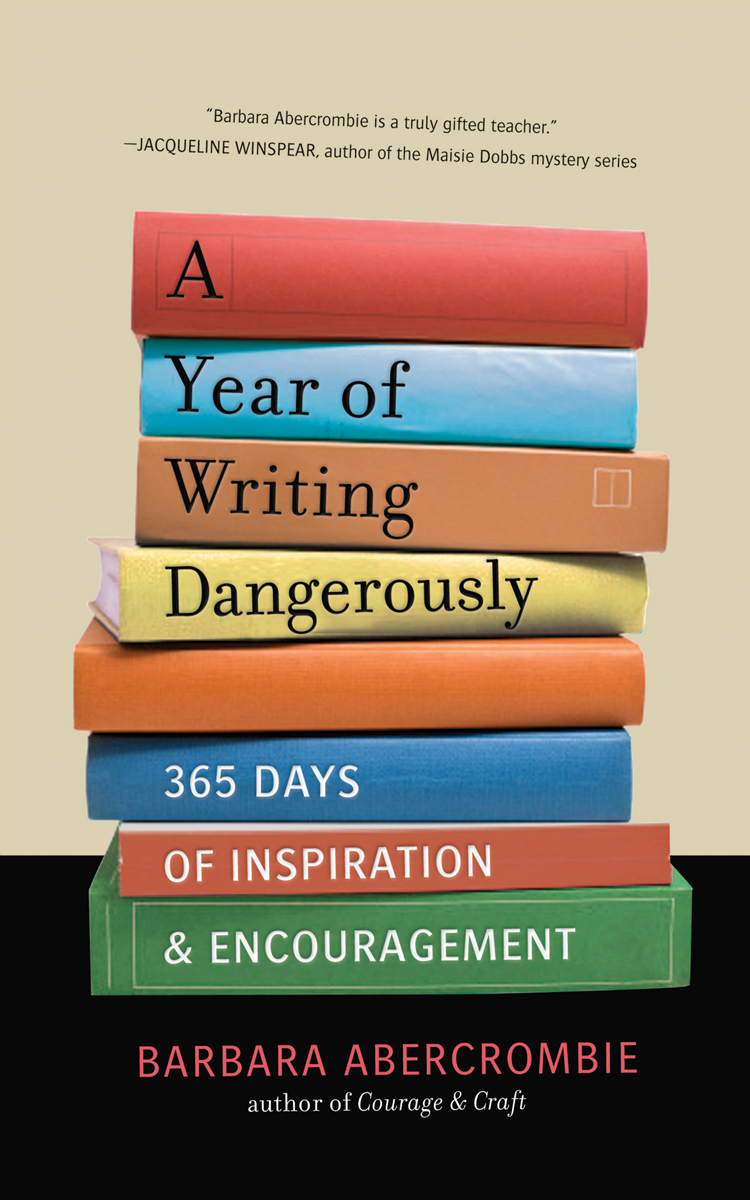
Year of Writing Dangerously by Barbara Abercrombie (book review)

This blog was never supposed to be about writing. Still, I  have been thinking and writing a lot about writing lately. This blog has put me in touch with a community of people are also thinking and writing a lot about writing. We are always seeking inspiration, communion and support. To those friends, I recommend Barbara Abercrombie’s Year of Writing Dangerously: 365 Days of Inspiration & Encouragement

As the title suggests, it is basically intended as a year-long writer’s toolkit for inspiration. I read it in 3 days. The entries are short — one or two pages for each day. Abercrombie provides practical, encouraging advice for writers. She does not pander or become too precious. She appreciates that writing is a struggle but doesn’t get wrapped up in the romance of that struggle.

She offers great quotes and stories from effective writers from across time. She blends their advice into a few basic tennets:

  • People who want to write better or write professionally must write every day.
  • Writers must read a lot.
  • Writers need a support network of disinterested peers who can criticize in a positive, ruthless manner.
  • Family members should not read what we write until the work is published and it is too late to turn back or make changes.
  • The best writing results from taking bad stuff out more than from adding good stuff in.
  • Unfortunately, it is as difficult to write a really bad book as it is is to write a really good book.
  • Always finish. Unless you can’t. Then don’t finish.
  • Find your process and stick with it. What works for others may not work for you. There is no recipe.

abercrombie-final.inddThe appendix offers the gift of 52 writing prompts to unstick stuck writers. They are pretty good.

Just a few pages into the book made me feel like writing. If you write or spend lots of time thinking about writing, you will enjoy this book very much.

On Monsters by Stephen Asma | Book Review

Stephen Asma’s On Monsters offers an enjoyable, if somewhat fractured, survey of monsterology through the ages. Monsters pre-date horror films and ghost stories. The concept of the “monstrous” has always been part of human experience. Each age understands monsters differently. The first half of On Monsters explores evolving understandings of monsters. In general, monsters stand outside normal experience. Monsters personify those things we do not or cannot understand. Monsters are a manifest acknowledgement of the limits of human understanding. As these limits change, our monsters change. Monsters dwell in the places we believe to be unknowable.

For the ancients, the unknowable places were empty spots on the map. This gave us the great sea monsters and terrible, cannibalistic races that inhabited the oceans and unfamiliar continents.

In Biblical times, monsters were agents of God, mysterious and unfathomable. Think Leviathan.

The earliest monsters were thought to be part of the natural order. They walked among us and lived in places we could not or should not go.

Medieval monsters were supernatural – witches and demons. They didn’t live in a special place of their own. They lived everywhere and regularly intervened in the lives of the non-righteous.

With the Enlightenment, came the medical fascination with mutation and physical aberration in the human family. “Monsters” were no longer mythical. They were miscreants, captured and preserved in jars, and offering a measure of enjoyable frisson for collectors of oddities and the paying customers of these collections. The Mutter Museum is one of the most famous collections.

Over the past 200 years or so, our ideas about monsters have become internalized and have represented what we believe we cannot understand about ourselves. Modern times have been preoccupied with psychological monsters, like serial killers, tyrants and sociopaths.

Asma is at his best theorizing on the horror genre as the “art of human vulnerability”. He is particularly clever in his discussion of slasher films and “torture porn” and how they either explore or exploit the understood limits of human vulnerability to either empower or debase.

The second half of the book is less successful. Asma struggles with contemporary notions of the monstrous in the fields of cosmetic surgery, terrorism, robots and cyborgs. This is fertile ground for exploration but he does not bring these threads to any satisfying conclusion.

For most of human history, monsters were aberrations from the intended order of things. With the advent of biotechnologies and cybernetics we are faced with the possibility that there may be no final intended order of things. If there is no intended order to things, then some would suggest there can be no monsters. Everything becomes monstrous. Asma does not reject the promise of the new technologies to improve the quality of human life. But neither is he willing to abandon the concept of the monstrous as a useful indication of something still somewhat poorly defined.

What the Internet is Doing to Our Brains (a mid-book review)

I am halfway through Nicholas Carr’s The Shallows: What the Internet is Doing to Our Brains. Carr is the guy who wrote the excellent Atlantic essay “Is Google Making Us Stupid?” several years ago in which he documented his personal sense that reading online was somehow ruining his familiar mental habits — namely, concentration and focus. “Ruining”, I thought at the time, was an unfairly harsh term. He takes a more nuanced, thoughtful approach to his own experience of reading in the book-length study.

Page 125 of a 224 page book is not the ideal place from which to write a review. That said, I am ready to recommend this book to anyone who wants to understand what is probably happening to us in the age of ubiquitous internet access. Carr’s argument expands on the theme established in his Atlantic essay: the internet is destroying our ability to read deeply and engage with text-based narrative in a linear, hierarchical, rational fashion. Hypertext and multimedia “enhanced” text is changing the experience of reading and rewiring the way our minds are able to read.

The Atlantic essay struck me as alarmist, reactionary even. The Shallows places the new ways of thinking engendered by the internet into the context of other mind-altering technologies that actually changed the way our brains worked: the alphabet, numbers, the map, the clock, the codex. Carr examines how these new technologies of intellect have made entirely new thought processes possible and, thus, altered physical structures in the human mind. These changes play out over the course of millennia but they also play out in the course of a human lifetime. In the case of the internet, these changes may play out in a matter of days or weeks.

There’s a lot of strong scholarship in this book. I will come back for a better review 100 pages from now. For now, I just want to share how impressed I am with Carr’s ability to summarize the history of technological innovation, describe how it works and create a meaningful context that is value-neutral and does not necessarily crown contemporary humans as the apotheosis of what we will become. We are not necessarily destined to remain as we are. We are most likely destined to continue our process of becoming something else. This has happened before. It is going to happen again.

Carr says it better. Here’s a great passage from his chapter on the history of reading aloud vs. reading alone:

Like our forebears during the later years of the Middle Ages, we find ourselves today between two technological worlds. After 550 years, the printing press and its products are being pushed from the center of our intellectual life to its edges. The shift began during the middle years of the twentieth century, when we started devoting more and more of our time and attention to the cheap, copious, and endlessly entertaining products of the first wave of electric and electronic media: radio, cinema, phonograph, television. But those technologies were always limited by their inability to transmit the written word. They could displace but not replace the book. Culture’s mainstream still ran through the printing press.

Now the mainstream is being diverted, quickly and decisively, into a new channel. The electronic revolution is approaching its culmination as the computer — desktop, laptop, handheld — becomes our constant companion and the Internet becomes our medium of choice for storing, processing, and sharing information in all forms, including text. The new world will remain, of course, a literate world, packed with the familiar symbols of the alphabet. We cannot go back to the lost oral world, any more than we can turn the clock back to a time before the clock existed. “Writing and printing and the computer,” writes Walter Ong, “are all ways of technologizing the word”; and once technologized, the word cannot be de-technologized. But the world of the screen, as we’re already coming to understand, is a much different place from the world of the page. A new intellectual ethic is taking hold. The pathways in our brains are once again being rerouted. (77)

This is a very enjoyable, well-researched, well-built study. I just hope there are still people out there able to sit still long enough to enjoy it.

Jonah Lehrer is still okay with me

Jonah Lehrer may or may not be a dirty, low down self-plagiarist. I don’t care. I’m not feeling the kind of outrage that is circling the blogosphere. It is probably unwise to cut and paste choice quotes, even your own, from one online publication to another. It certainly seems a lazy thing to do and hurts the credibility of a brand that depends entirely on credibility  (Lehrer as “idea man”).

I still like Jonah Lehrer. I was reading Imagine: How Creativity Works when all of this blew up. The book is insightful and offers inspiring thoughts on how creativity works and can be made to work better. Here are a few things I carried away:

  • Creators don’t always have to understand the meaning of what they create. Sometimes the work is better when they don’t. See Bob Dylan.
  • The mind only creates new things when it is able to idle and assimilate ideas, thoughts and experiences.
  • We learn best through play.
  • Social networks, particularly weak ties, are essential for generating and executing new ideas.
  • Humans are social. We create more effectively when we interact with other people.
  • Criticism is good. Brainstorming is bad.
  • Our history is punctuated with periods of excess genius. These periods can be studied, understood and, possibly replicated.
  • Shakespeare wasn’t a fluke but he might not happen again.

I plan to read How We Decide soon. I will reserve judgment until I find out if that is the same book with a different cover. If so, no mercy. Until then, Jonah Lehrer is okay with me.